

By Jennifer Primrose
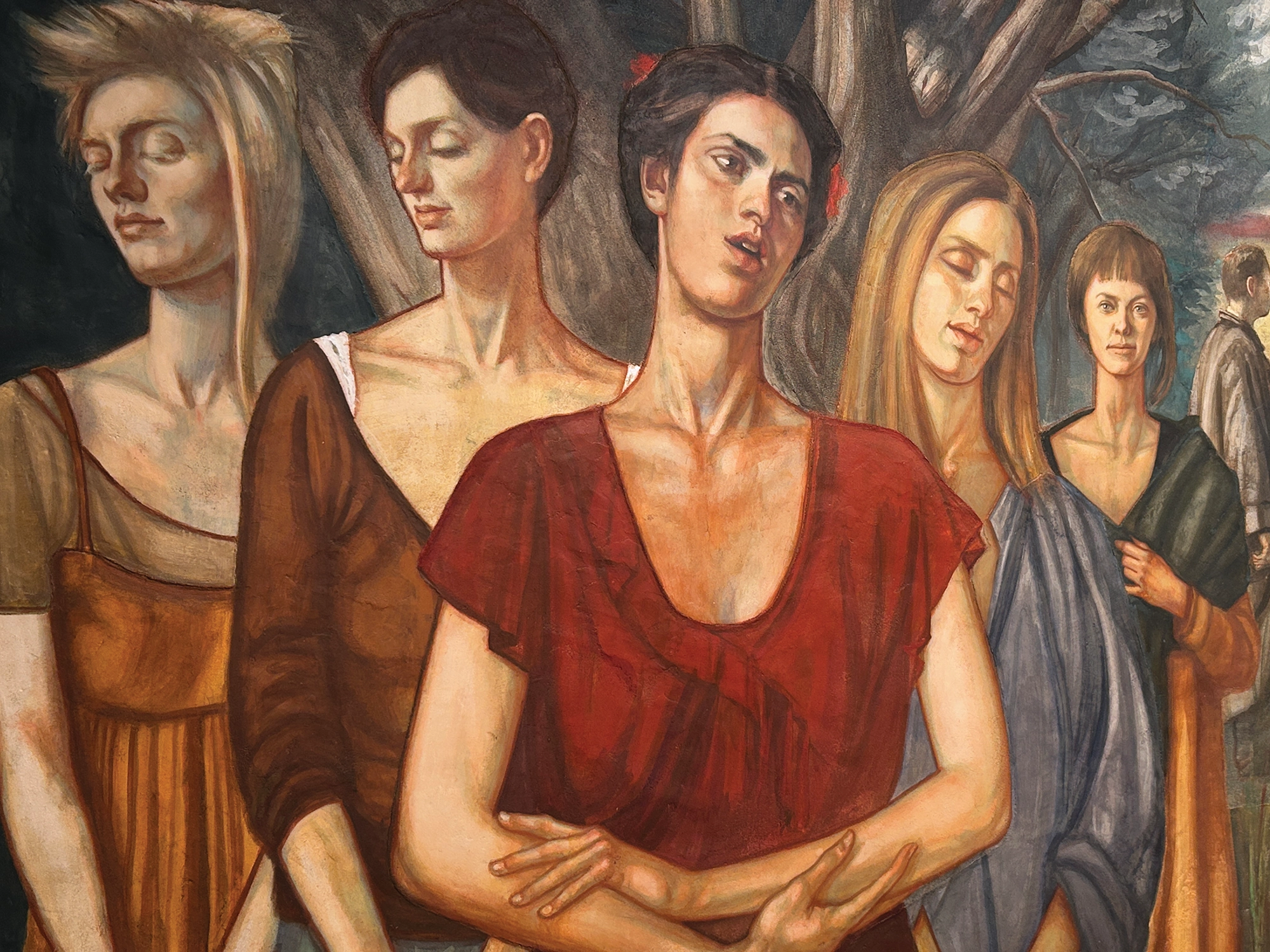
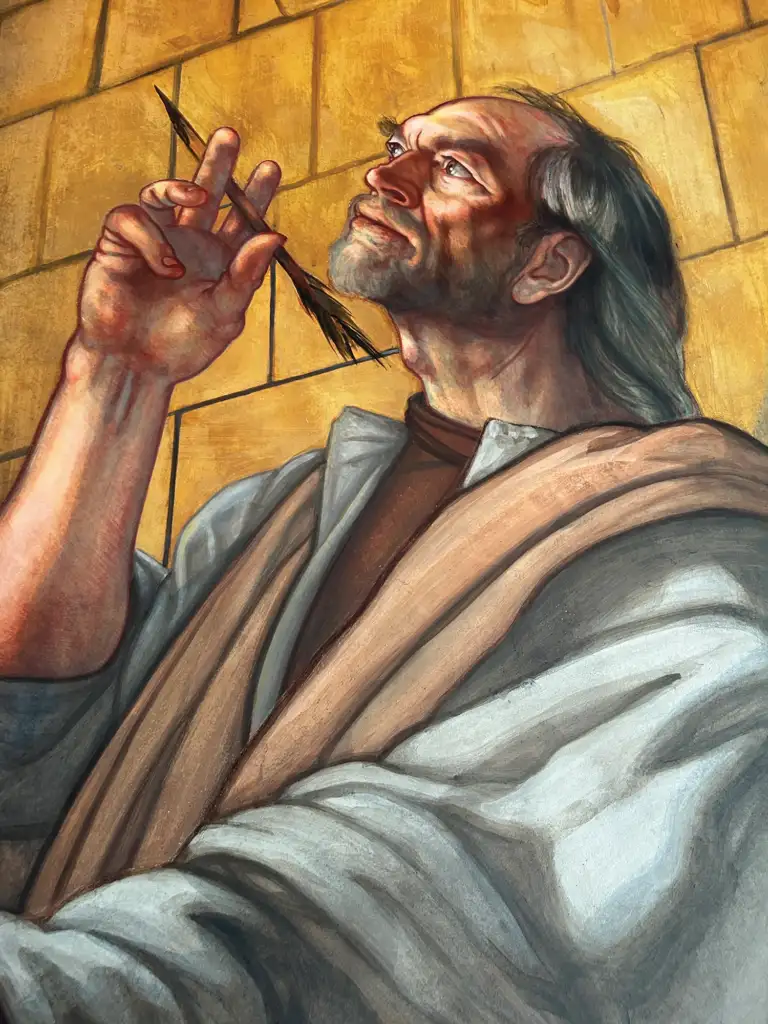
If you’ve ever wandered into a small mountain church or a quiet civic building in North Carolina and felt like the walls were watching you back, chances are you’ve crossed paths with a Benjamin Long fresco. These aren’t your typical murals. They’re true frescoes painted directly onto wet plaster so that the pigment becomes part of the wall itself. And the process? Well, it’s as unforgiving as it sounds.
Long is one of the few American artists today closely associated with this centuries-old technique. If you’ve seen his work throughout the state, it’s hard not to be captivated. I first encountered his frescoes at St. Paul’s Episcopal Church in Wilkesboro, where the figures on the walls seemed to shift with the light, almost breathing within the architecture. Their faces felt both familiar and timeless, and the weight of the composition gave the space a quiet sense of reverence—even outside of worship hours.
Later, in Blowing Rock, I came across another pair of Long’s works at Rumple Memorial Presbyterian Church. The frescoes immediately caught my attention, each detail revealing both Long’s technical precision and the care of the community that helped preserve them. One fresco depicts the 23rd Psalm, the other the Good Shepherd. Originally commissioned by Mabel Stowe Query in 2006 for a hospice center in Mount Pleasant, South Carolina, the works were completed in 2009.
Rumple acquired the frescoes in 2022 and stored them until the church was ready for permanent installation. Today, visitors can get a closer look—and a deeper understanding—through an introductory eight-minute video and hourly docent presentations offered by the church. Experiencing them in person reinforced how naturally the figures inhabit the space, quietly inviting visitors to pause and take it in.
After witnessing these walls come to life, I knew I wanted to learn more about the artist responsible for this work. Reaching out to Ben Long opened the door to a much larger story—one that stretches from Italy to the mountains of North Carolina. Along the way, I discovered his frescoes scattered across the state, from Charlotte’s skyscrapers to towns like Glendale Springs, Wilkesboro, and Blowing Rock. Each carries its own story and its own connection to the community around it.
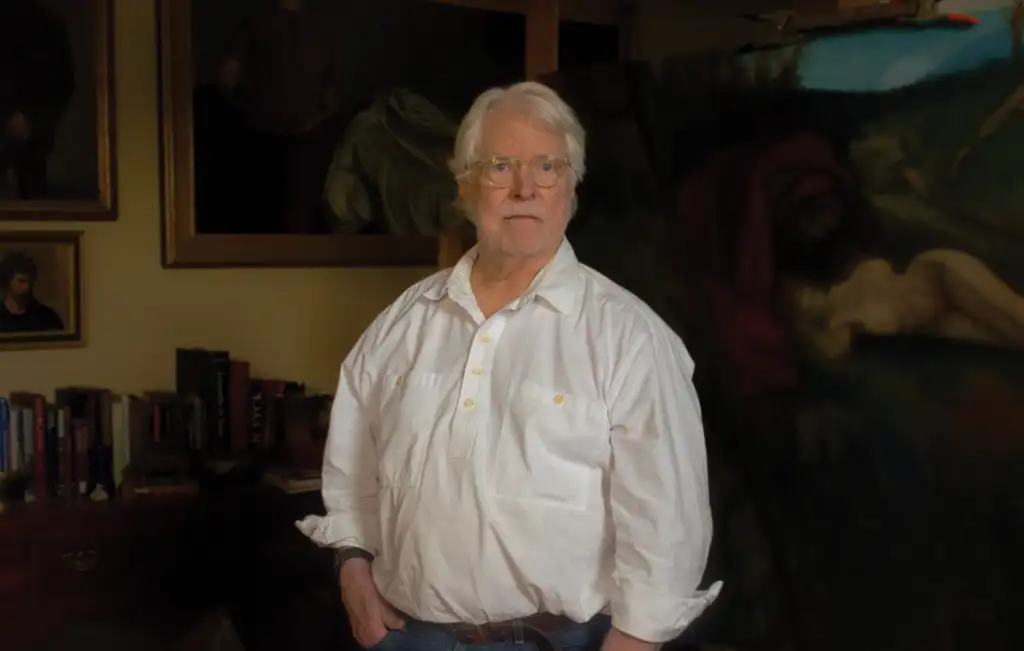
Long’s journey toward mastering fresco began far from North Carolina. He spent nearly a decade in Italy studying under the renowned portrait painter Pietro Annigoni, whose work centered on classical training in drawing, portraiture, and anatomy.
“I went to Italy to study with Annigoni and learned fresco simply because that was what he was doing at the time,” Long tells me. “What he emphasized most—and what I instinctively understood—was the importance of drawing. Those fundamentals were the foundation of everything.”
It was during this time that Long fully embraced fresco as his medium. For those unfamiliar with the technique, the explanation is simple: Fresco means “fresh.” The artist paints on wet plaster made of lime and sand, working within a limited window of time before the surface dries. “Everything has to come together within that window,” Long says. “The artist needs to know exactly what they’re doing before they even begin.”
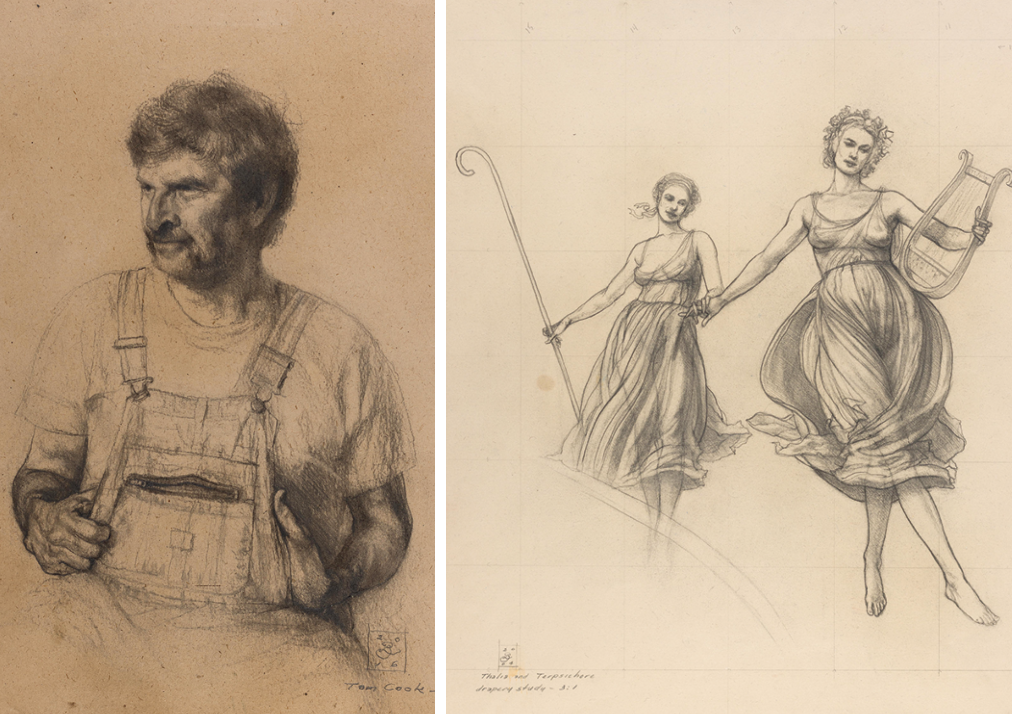
That time constraint leaves little room for hesitation. Every figure, every line, every shadow must already be worked out before the brush ever touches the wall.
When Long returned to North Carolina after his years in Italy, he found himself confronting a striking gap: The medium he had devoted years to mastering was almost entirely unknown to the people around him. That discovery shaped the direction of his work going forward. “Fresco work made me realize that most people in North Carolina had no real idea what fresco was,” he says. “That inspired me to show both fresco and oil painting here—portraiture, landscape, the figure—and to continue that tradition and share it with others.”
One of the most meaningful examples of that mission can be found at Holy Trinity Church in Glendale Springs. There, Long worked on what he describes as a true “community fresco.” Local residents served as models for the figures, while members of the surrounding community supported the artists during the church’s restoration. “It was wonderful. It was a step in the right direction—a real community fresco,” Long says. “Fresco was traditionally done with the community and for the community, giving art to the people.”
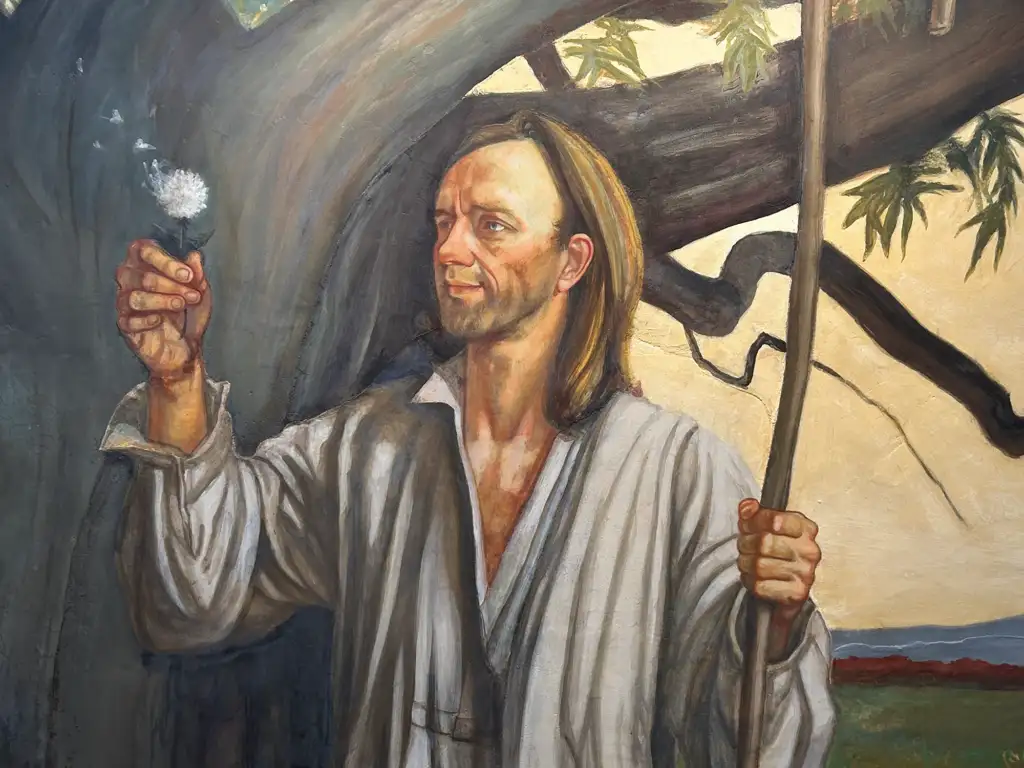
The project reflects a unique aspect of the medium itself. Unlike a painting that can be hung, moved, or sold, a fresco becomes part of the building where it’s created. The art and the space are inseparable.
Long has also brought that same discipline into secular settings. In Charlotte, his frescoes inside the Bank of America Corporate Center demonstrate how the technique can extend beyond religious themes. “The approach to the fresco itself isn’t really different—the technique and discipline remain the same—but the subject matter opens up,” he explains. Working in a corporate setting allowed him to explore symbolism and philosophical ideas outside of a strictly liturgical narrative.
What strikes me most about seeing these works in person—whether in Wilkesboro, Blowing Rock, or inside a towering Charlotte skyscraper—is their sense of permanence. A true fresco ages with the building, moving with it and responding to shifts in the structure itself.
Long recalls a fresco near St. Peter’s Basilica in Italy that collapsed after structural stress caused part of the wall to fail—a reminder that frescoes are as vulnerable as the buildings that hold them. Unlike a canvas painting, they can’t simply be removed or relocated if the structure changes.
Long’s life outside the studio has also shaped his perspective as an artist. Before studying in Italy, he served in the US Marine Corps during the Vietnam War, working on a Combat Art Team tasked with documenting scenes of conflict and humanity. The experience left a lasting impression. “My experiences in the Marine Corps had a very powerful and lasting effect on me throughout my entire life, including my art,” he says.
That same discipline carries into the studio. “By the time I’m standing in front of the wall, I’ve already thoroughly explored and studied what’s going to be there,” Long says. “When I get to the wall, I simply think to myself, ‘It’s time to paint.’”
When I asked what he hoped people would carry with them long after a fresco was finished, his answer wasn’t about a specific message or interpretation. “It’s less about a particular idea and more about continuing to fill and lift my own spirit through this particular vessel,” he says.
And perhaps that’s the quiet power of Ben Long’s frescoes. You might encounter one unexpectedly, inside a small mountain church or tucked into a city building, and suddenly realize that the wall in front of you isn’t just painted. It’s alive with color, history, and human hands that once worked against the clock to bring it into being. Ben Long’s frescoes are quietly spectacular—an ancient technique still unfolding in the 21st century, embedded not just in plaster, but in the communities that surround them.