By Dathan Kazsuk | Long before M Sushi became one of the Triangle’s most talked-about restaurants, and before Durham became the center of his growing M Restaurants world,…
By Sofia Lujan | Kenda Kistenmacher is the founder and designer behind the Raleigh-based jewelry brand Kenda Kist—a collection of hand-forged, everyday fine jewelry rooted in metal design…
By Dathan Kazsuk | Goats On The Go is helping Carolina Tiger Rescue clear invasive plants with goats, offering a quieter, eco-friendly way to manage the sanctuary’s land.
By Deanna Bey | Originally started out in Texas, Summer Moon Coffee has built a loyal following around its oak-roasted coffee and famous sweet cream, Moon Milk.
By Kyle Marie McMahon | Named after the “feel-good” chemical serotonin, Serotone Swim is built on the belief that when we feel supported—literally and figuratively—our entire presence changes.
Are you considering breast surgery and wondering whether implants or a lift are right for you? This is a popular concern from patients at Tannan Plastic Surgery, especially as factors like…
Your home is more than just where you live—it’s where your family grows, relaxes and creates memories. Creating a healthier and safer environment is essential, and replacing old windows and…
Workstation sinks that inspire home cooking The best meals start with more than just great ingredients; they begin with a space that makes cooking feel effortless. A smart kitchen setup…
There are interviews that happen in conference rooms, over speakerphone, or through the tiny window of a Zoom call, where everyone pretends the lighting is fine.
And then there are interviews like this.
I met Dan Winger one afternoon at Salty Turtle Beer Co. in north Raleigh, where we sat down over a couple of hazy IPAs and talked about creativity, career pivots, and what happens when a former LEGO Master Designer decides the world needs a barroom game that requires neither electricity nor a screen.
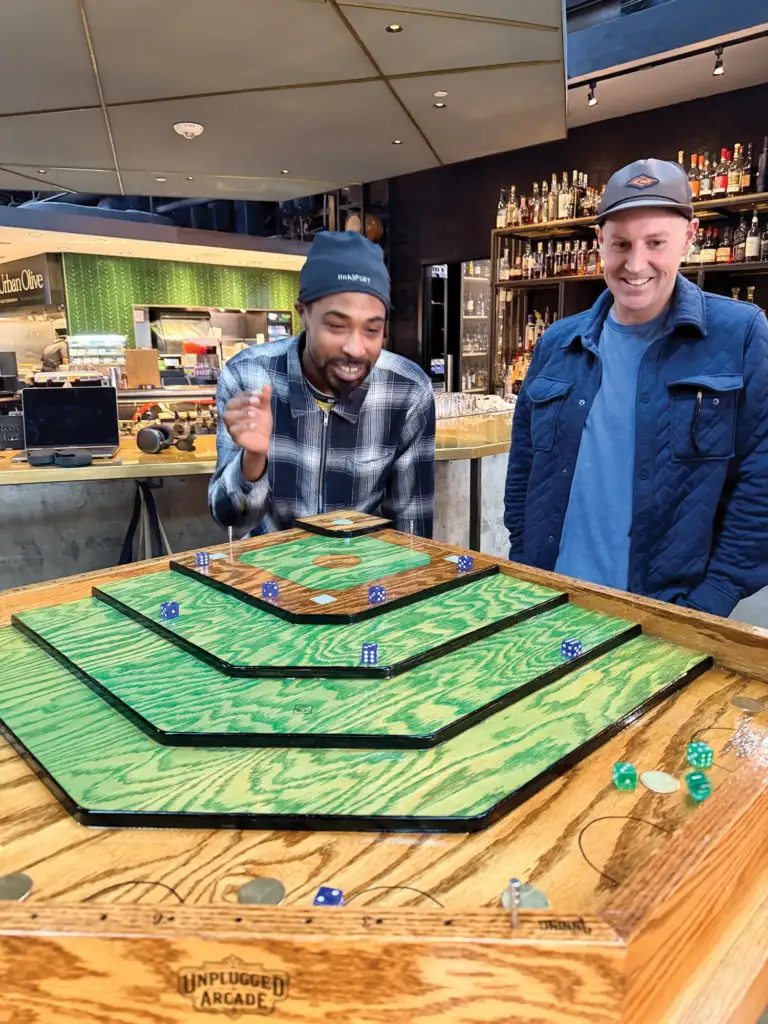
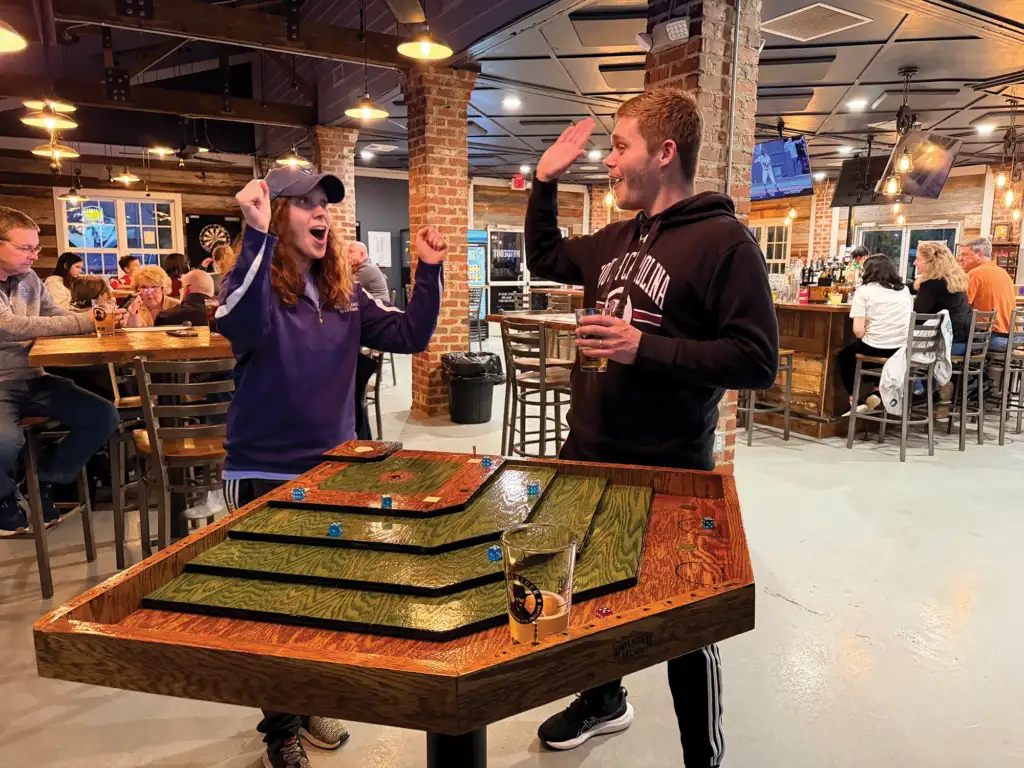
Winger is the creator of Unplugged Arcade, a Raleigh-based gaming concept built around physical, social, and analog play. His first game, Baseball Shuffle, lands somewhere between board game, bar game, and that dangerous category of “just one more round.”
Before moving to North Carolina, Winger spent 18 years with LEGO, where he worked as a Master Designer on the company’s product innovation team. Much of that work focused on new product lines and digital integration—augmented reality, emerging technology, and ways to blend digital play with LEGO bricks.
“We were responsible for launching new product lines,” Winger says. “Most of that had digital integration, so a lot of that time was looking at augmented reality and how you fuse digital play with LEGO bricks.”
The job began in Los Angeles with a small team that expanded and grew closer to LEGO’s European operations. During Covid, Winger went remote and eventually moved to Raleigh with his family. “We were researching family-friendly cities,” he says. “Raleigh was the only one left. It was schools, parks, safety, cost of living—and we fell in love with the nature out here.”
Photo courtesy of Unplugged Arcade.
But when company policy required employees to return to an office, Winger found himself at a crossroads. He started testing new ideas, including a political satire card game, but that project didn’t stick. Then he returned to an idea that had been sitting in the back of his mind—a large-scale, physical game inspired partly by Tumblin’ Dice.
That experiment opened the door.
“Once you get the bigger game, you have what video games refer to as game feel,” Winger says. “It just feels good.”
That concept—game feel—became central to Baseball Shuffle. Winger wanted something tactile, satisfying, and easy to approach.
“I started looking into it, and there’s nothing in the space,” he says. “Where pool tables and shuffleboards are, nobody’s doing product elevation in there.”
That realization helped shape Unplugged Arcade. Winger describes the company as occupying “the entire space between board games and barroom games,” with a footprint smaller than a pool table or shuffleboard, but more substantial than a typical tabletop game.
Baseball Shuffle is baseball-inspired, but Winger says he came at it less as a sports obsessive and more as a designer.
“I was a fan growing up,” he says, noting his childhood Chicago Cubs fandom and later connection to the Minnesota Twins. “But I came at this from a game design and product innovation perspective.”
Photo courtesy of Unplugged Arcade.
BASES LOADED
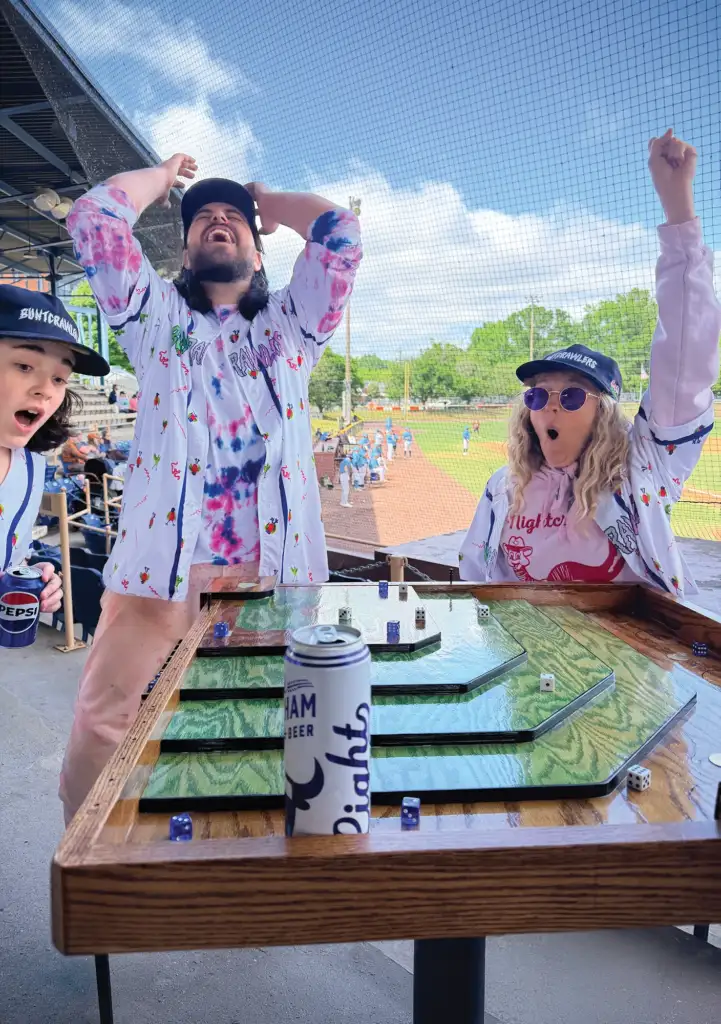
The game supports 2—16 players and has already been tested with groups of up to 10. That flexibility is part of the point. Traditional bar games often work best with two or four players. Baseball Shuffle is meant to open the door wider, letting bigger groups play together without one expert demolishing the poor soul who just wandered over with a beer in hand.
“My goal was to address a lot of these opportunities,” Winger says. “Make a game that has a more flexible player count and introduces skill with luck. The luck brings bigger moments, and it also bridges the skill gaps.”
Winger designed the game with breweries and bars in mind. The board includes drink-friendly features, with beverage placement integrated into the strategy. Drinks can act as bumpers for the game pieces, giving players a small sense of control over the chaos.
Baseball Shuffle is already showing up at Triangle breweries and bottle shops, including Salty Turtle, Crank Arm Brewing, Trophy Brewing Co., Komana, Hoppy Tales, and The Corner Biergarten. “My goal is to build a player base and build a community of people engaging in the game,” he says. “That will drive interest for venues to buy the game.”
He’s also connected with local baseball groups like Carolina Sandlot Collective and MLB Raleigh, and is exploring larger tournament-style events with brewery-sponsored teams.
The first boards were handmade by Winger himself—roughly 20 to 25, each taking an estimated 12 to 15 hours in batch production. Now that demand is growing, he’s working with a shop in Chapel Hill to produce the games.
Photo courtesy of Unplugged Arcade.
CONFIDENCE SOLD SEPARATELY
And yes, after we talked, Winger showed me how to play.
I’d like to say I immediately displayed natural talent and the strategic instincts of a man who once watched an alarming amount of baseball. That would be a lie.
But the game was fun. The kind of fun where you start adjusting your approach after each turn, quietly building theories in your head like a mad scientist with a pint glass.
By the end, I was already thinking about angles, placement, and how I would play differently next time—which is probably exactly how Winger knows the game is working. He actually showed me a new way to play the game, which I think will make it much more strategic.
Unplugged Arcade isn’t trying to replace the arcade.