‘Like I hit the Lottery’
BY KURT DUSTERBERG
When Erin Matson led UNC–Chapel Hill to the NCAA field hockey national championship last November, it was the finishing touch on one of the sport’s most remarkable careers ever. The Tar Heels’ national title was the fourth for Matson, a three-time recipient of the Honda Sports Award as national player of the year.
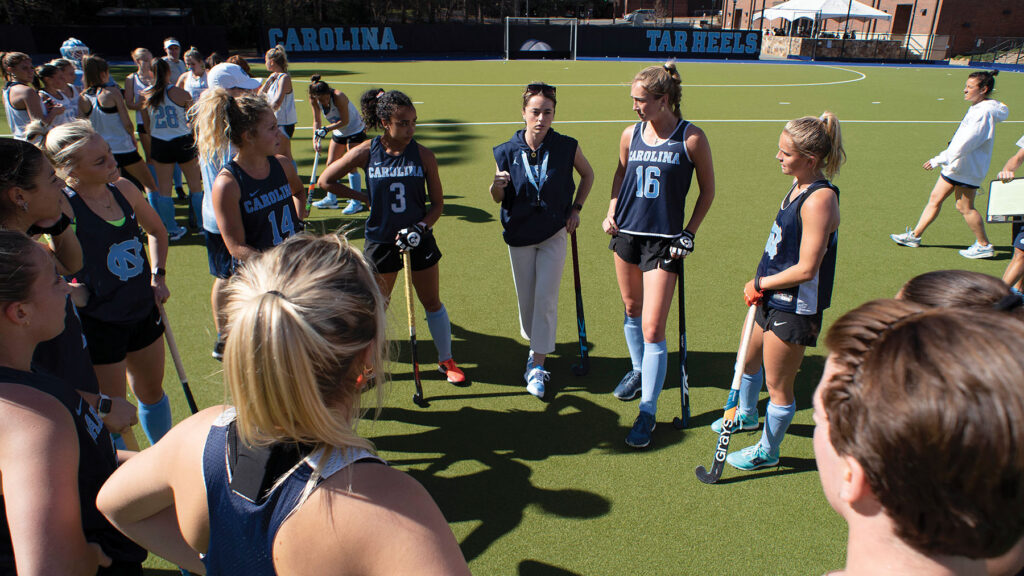
But instead of taking her public relations and marketing degree out into the working world, the fifth-year senior was presented with an unlikely opportunity. Head coach Karen Shelton stepped down after 42 years and 10 national championships, so Matson applied for the job. She was introduced by UNC Athletic Director Lawrence “Bubba” Cunningham as the new coach on January 31.
At age 23, Matson is the youngest collegiate coach in the country, a high-risk situation in the world of college athletics. “That’s part of the reason that I was hired, that I am so young,” Matson says. “I’m so relatable. I know exactly what the kids want because I think the same way.”
Field hockey programs don’t make or break athletic departments, but the eyes of the sport are on Chapel Hill, where UNC has won the most championships since the NCAA sanctioned the sport in 1981. So Matson had to make the transition from player to coach quickly.
“I’m still myself. I’m not changing,” she says. “Bubba doesn’t want me to change, but at the same time, I have the responsibility of a program and other young women to empower and manage. When we’re in the office, let’s flip the switch. I always have to have the coaching hat on.”
Matson has come a long way since her mother, a former field hockey goalie at Yale University, signed her up for a clinic when she was 6 years old. As the years passed, Matson was always the youngest kid at camps—the petite girl issued the extra-small jersey with No. 1 on the back, the same number she wore at Chapel Hill. “I just fell in love,” she says. “I couldn’t get enough of it once I picked up a stick.”
You’ll be coaching the same athletes you played with last season. I’m sure you’ve given that some thought. How do you prepare for that transition? From the day I got the job [I said], ‘Hey, we need to be open and honest to get through this. It’s unique, it’s different. Let’s not make it weird.’ I really think transparency and support of each other has helped. It’s the role of
any coach to be that consistent person and have that open-door policy for your players. It’s the only reason this is possible.
How has North Carolina built such a dominant field hockey program? We’ve always had a really good balance of those high standards, that we’re not going to accept anything that’s mediocre or average. We’ve also taken time to really enjoy what we’re doing and enjoy each other. Yes, we want to get better and have that killer mentality, but at the same time, we really love the people around us and want to do it together. We really do take the time to understand each other. We’re pretty drama-free. Let’s all look out for each other. Then on the field, we will do anything for
each other.
Let’s talk about your career. You’re the all-time leading scorer in the Atlantic Coast Conference and in NCAA tournament play. You’re the three-time national player of the year. There’s a case to be made that you’re the best player who has ever played your sport.
Do you ever think about that? Well, thank you for the kind words. I think I’d be lying if I said that thought didn’t cross my mind, but I never let myself ponder about it. I was fortunate to be able to accomplish a lot and set a lot of records.
But I felt as a student athlete, it’s my job. Let’s perform, let’s set those records, let’s get exposure to our sport. I hope one day another person comes along and sets a new standard. I’ve never really dwelled on what I’ve done.
I’ve always taken the mindset of, what’s left to do? It’s cool to think about, and it’s an honor. That’s great, but it’s in the past. There’s still plenty to accomplish.
Field hockey has always been a niche sport. Are there barriers to entry in the sport? Is there a path to making it more accessible for girls to play? It is an expensive sport. The equipment is expensive, especially for goalies. Another hurdle is it can’t be played on grass, it can’t
be played on multipurpose turf.
It needs the true astroturf to be the true game. You don’t see million-dollar fields put up everywhere. It’s been a primary focus for USA Field Hockey for years to get it in the inner city. There are so many sports for kids to choose from, but it’s not a sport that’s very easily understood. There are a lot of subjective rules, so it makes it tricky for people to understand it and buy into it. It’s an exciting game and people get pumped for the immediate time they see it. But then it’s like, ‘Wait, I actually have no idea what’s going on.’ So, getting people to understand it is another hurdle.
What kind of expectations do you have for your tenure at Carolina? The obvious one is bringing a trophy back to Carolina, but we can only do that one game at a time. I think the team knows that. It’s something I’ve always had throughout my career. As long as we’re taking care of the job that we need to take care of right now, things will fall into place. We have our end goal in mind and we know what it will take. If I can just do my job and be the best coach that I can for this program, then the domino effect will take care of itself.
How is the job going so far? I’m not in a job that’s just planning practice every day. I’m having fun because, yes, it’s that, and it’s something I care so deeply about and love. My whole life I’ve been a field hockey player. But I love marketing and branding. How is the university doing that? What maybe in promotions can we do? I love organizing and scheduling, so let’s schedule a season. Let’s watch the budget. And I think everyone thinks I’m crazy because I really am enjoying everything. Coaching is 5% of what we do. I think that’s why I’m in heaven, because I still have a taste of that. Yeah, I’m not out there still as a player, but I’m still involved in the game. I really feel like I hit the lottery for myself.