BY ANITA B. STONE
Covered bridges remind us of the past—a time when people traveled by horse and buggy or on foot to reach destinations like the general store, the millpond or the county blacksmith; a time when children skipped rocks across creeks and rivers, and when cowbells rang to announce dinnertime.
Many covered bridges were built in North Carolina during the 19th and early 20th centuries. Over the years, however, covered bridges became obsolete—in part because engineers began making trusses, the systems of beams that hold many bridges together, from metal rather than timber, which meant the bridges’ substructures no longer needed to be protected from water.
Covered bridges also only offered single lanes, had low width and height clearance, and often could not support the heavy loads of constant traffic. Many of their stone foundations began crumbling with age. Their remnants can be found today.
A few North Carolina covered bridges remain standing, however—restored as national landmarks and as part of North Carolina’s historical legacy.
Pisgah Covered Bridge
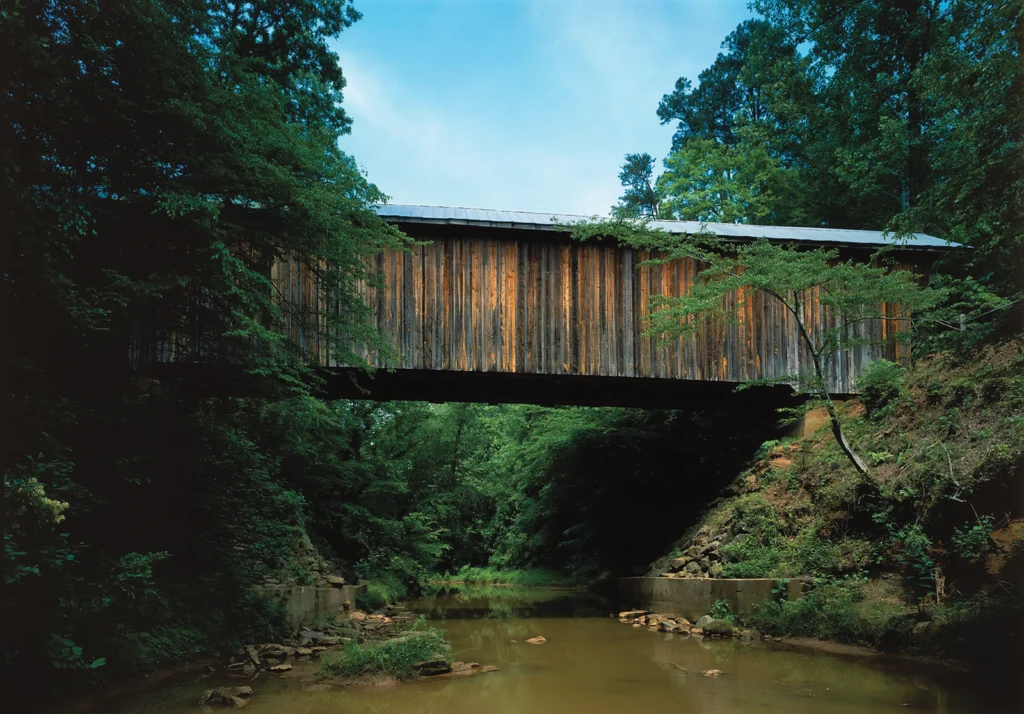
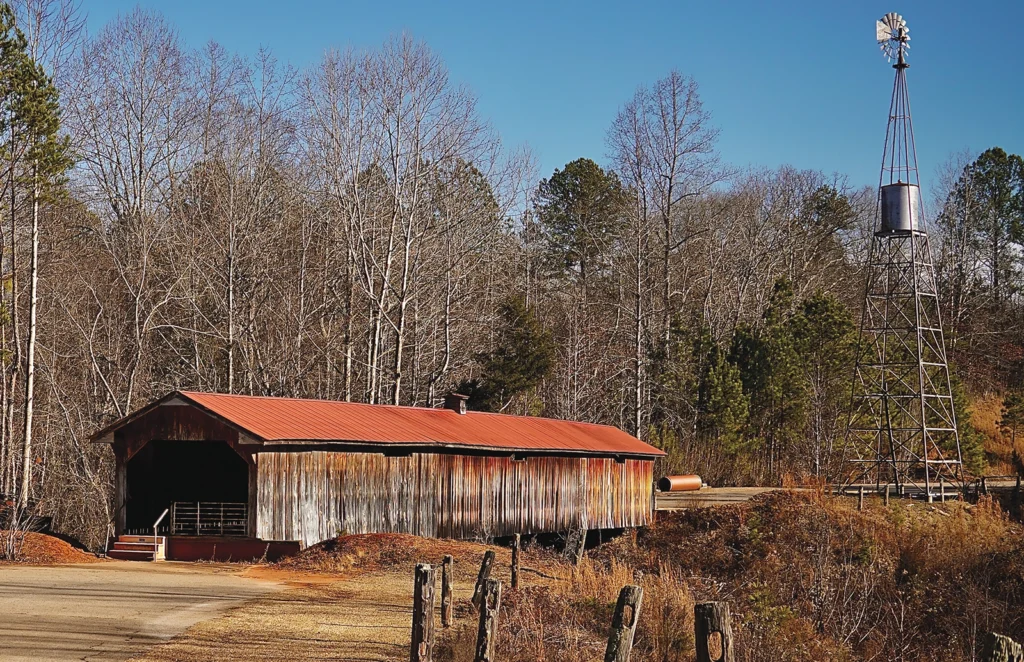
Built in 1911, the Pisgah Covered Bridge, located in Randolph County, is a popular tourist attraction. At 54 feet long, the bridge crosses the West Fork Branch of the Little River within the Uwharrie National Forest. It was added to the National Register of Historic Places in 1970.
The bridge was privately built from white oak and pine by J.J. Welch (rather than, like most North Carolina bridges at the time, being funded by the county) at a cost of $40. According to the Randolph County Public Libraries’ local landmark designation report on the bridge in 2004, local citizen Claude Morris reported that he was standing nearby watching when Matthew Cagle, the first person to cross the bridge, drove his wagon team across it.
“Are you sure?” asked the person interviewing Morris. “That bridge is over 90 years old! How old do you think I am?” Morris replied.
The bridge was washed away by a flood in 2003, but the community was able to salvage about 90% of the materials from the original structure, and the bridge was restored the following year.
Since 1998 the North Carolina Zoo Society has collaborated with the North Carolina Department of Transportation, Piedmont Land Conservancy and the LandTrust for Central North Carolina (now called Three Rivers Land Trust) to maintain the bridge.