

By Dathan Kazsuk
Suzanne Weerts has spent years telling stories on stages in Southern California, but many of the memories that shaped those tales began here in Raleigh.
Born in Charleston, South Carolina, raised in west Raleigh, and later a graduate of UNC-Chapel Hill, Weerts eventually made her way to California. But as many Southerners know, leaving the South does not always mean the South leaves you.
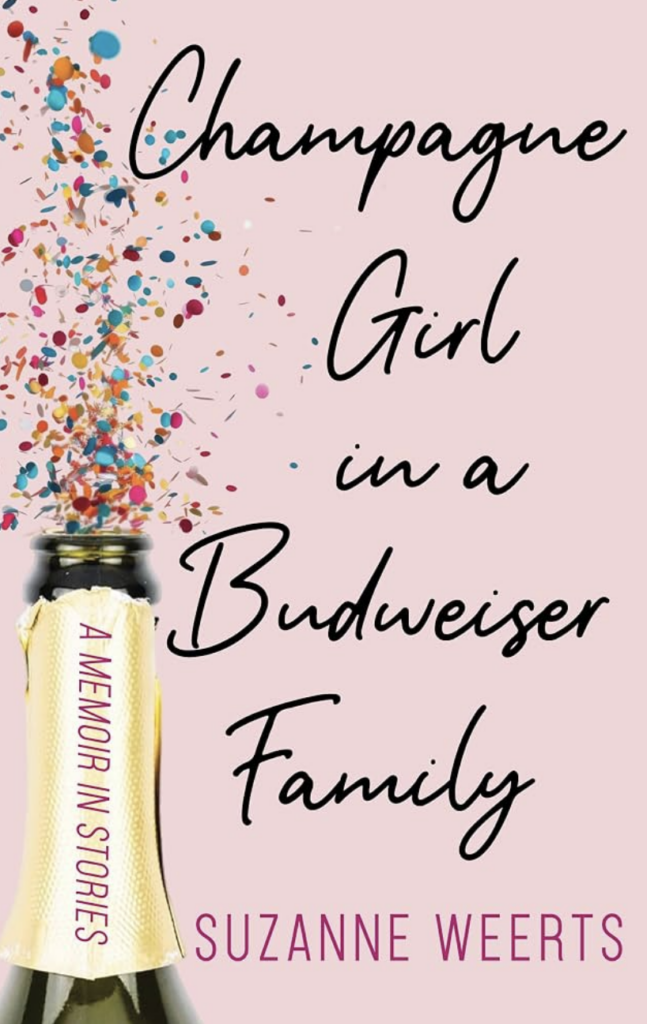
Her debut memoir, Champagne Girl in a Budweiser Family, is a collection of 52 short stories spanning her life from age 6 to 22, from childhood in Raleigh to the moment she left North Carolina for California. The book is funny, reflective, nostalgic, and honest, with stories about family, growing up as a woman in the 1970s and 1980s, and wanting something bigger.
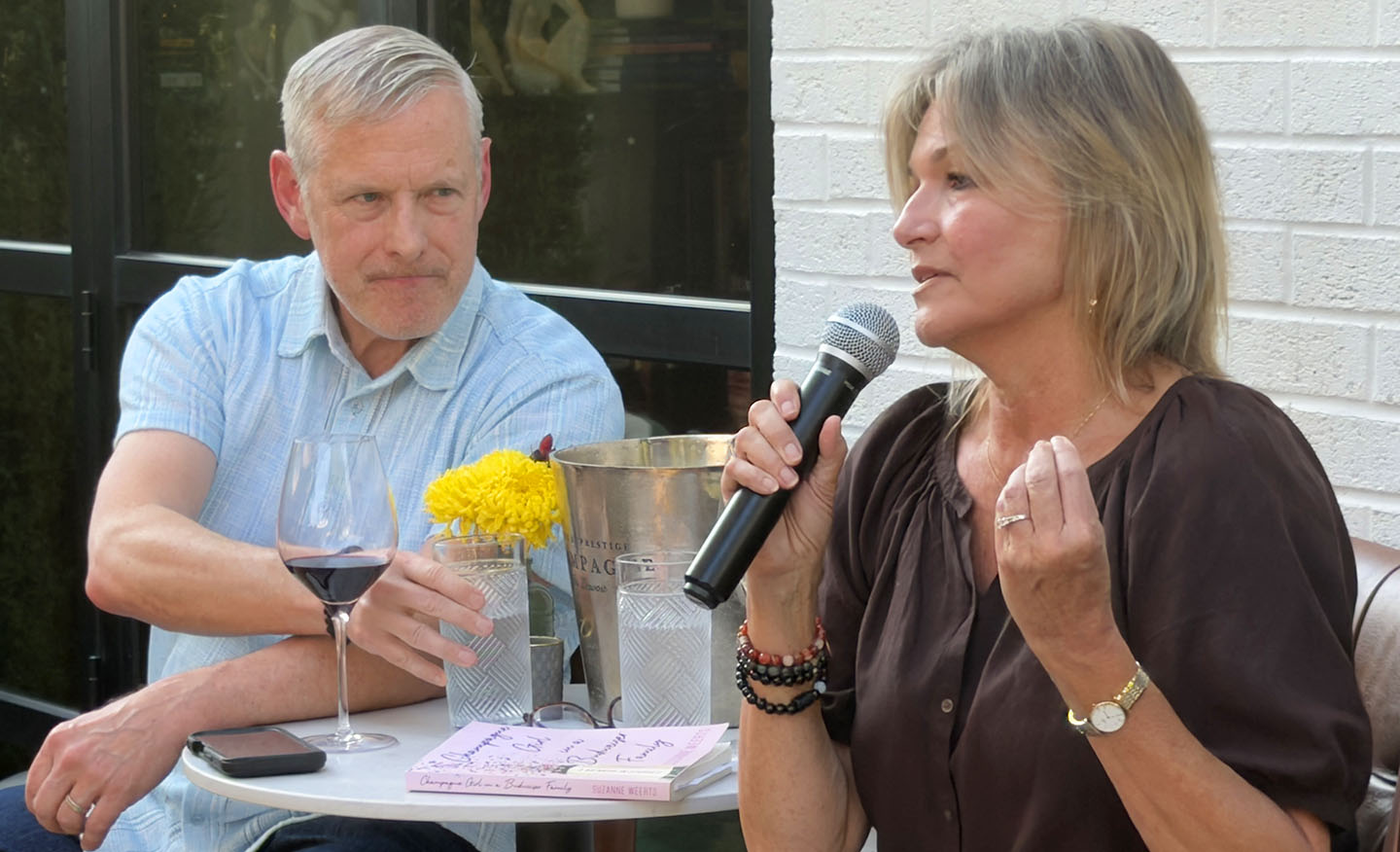
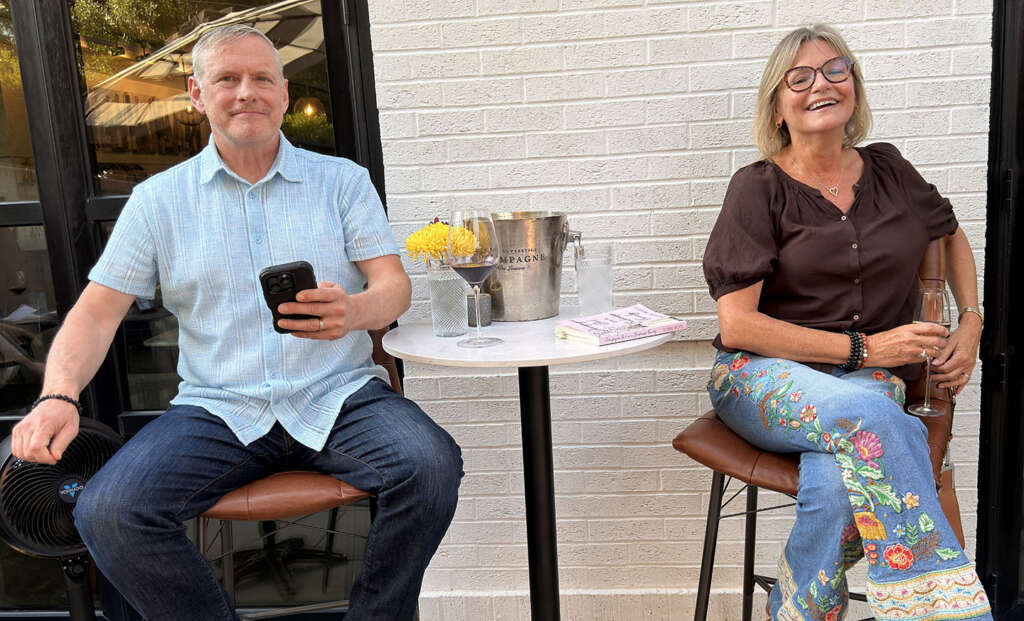
During a recent visit back to the Triangle, Weerts appeared at RBF, Your Authentic Champagne Bar in Cary, for a hometown event and conversation with longtime sports broadcaster David Glenn. For Weerts, the event was more than a book signing. It was a return to the place where many of the stories began.
I spoke with Weerts about storytelling, Raleigh, memory, her father’s house in west Raleigh, the meaning behind the title, and why sometimes the best stories are the ones you never set out to find.
When did writing and storytelling become part of your life?
I’ve been a writer to some extent all my life, but I didn’t really start doing this kind of storytelling writing until around 2014, when I started telling stories on stage.
I got involved with The Moth, which is live storytelling without notes. You get up on stage, and you have five minutes to tell a full story. That’s it. You have to have a beginning, middle, and end, and get the whole thing across in that short amount of time.
In Los Angeles, there are so many storytelling venues where people get up and share stories. I’ve been part of a weekly group, and over the course of 10 years, I’ve probably told about 150 stories on stage.
How did you figure out the structure of the book?
I was reading David Sedaris, and I realized he writes these individual story collections. They don’t necessarily have to be one long, traditional memoir with a single timeline.
I’m not comparing myself to him, though a couple of reviewers have said the book is kind of David Sedaris meets Judy Blume. It has that coming-of-age element, like Judy Blume, and then it has these semi-comedic, anecdotal stories.
The title “Champagne Girl in a Budweiser Family” is great. Where did that come from?
When I was growing up in Raleigh, my mother often called me her “champagne girl in a Budweiser family.”
Sometimes it had to do with clothing. I wanted the beautiful prom dress from Cameron Village, and I was told JCPenney had a sale, so we were going there. But it was also about wanting to do more than I was allowed to do, or wanting to take ballet, piano, and art classes, and being told I had to choose one.
I didn’t have a title for the book at first. Then I was at my daughter’s wedding in Oahu. My husband and I had given her a set amount of money for the wedding, and her fiancé’s mother had given them a set amount too, but they added a lot more because the wedding was really lovely. The rehearsal dinner alone was probably nicer than my wedding 30 years ago.
My husband leaned over and said, “Did we raise a champagne girl in a Budweiser family?”
And I said, “Honey, we’ve raised a champagne girl in a Heineken family. We’ve elevated just a little bit.”
What do you think readers are connecting with most?
The nostalgia.
The book has vivid descriptions of music, clothing, and generally relatable childhood experiences. People who grew up in the 1970s or 1980s really connect with it, but older readers do too. Childhood in the 1940s, ’50s, ’60s, ’70s, and ’80s was much more similar than childhood is now in the technological age.
That has been one of the fun parts of the book signings. People will tell me, “I haven’t thought about that in years.” The stories spark their own memories.
That’s the thing about nostalgia. It may not be your exact childhood, but one word can bring something back.
Exactly. Someone might read about one thing in the book, and suddenly they’re remembering something from their own family or neighborhood.
There is also a lot of vulnerability in the stories. It’s a coming-of-age book, and being a kid is hard. There are also reflections on what it was like to be female during that time period.
I was the first girl in the west Raleigh Little League program. I played baseball for one year, and I was quite terrible at it. I was making clover necklaces in the outfield. But I was there. Maybe in some little way, I broke that dugout ceiling so better players could do it.
At your Cary event, David Glenn was part of the conversation. What is your connection with him?
David was a junior transfer student when I was a senior at UNC, and we dated.
There is a story in the book where I write about him breaking my heart, but I changed his name. For people I actually name in the book, if there was any question they might find the story less than flattering, I ran it by them. In this case, I didn’t want to call him and ask if it was OK to tell the story about him breaking my heart. So I changed his name.
We’ve stayed friends over the years. He came to my wedding, and I would have gone to his, but my daughter had been born three weeks earlier.
I didn’t know David had read the book until Thanksgiving last year. He texted me asking how I was and how my family was, and then he signed the text, “Love, Dan.” Dan was the name I used for him in the book.
So when I knew I was coming back to Raleigh, I thought, wouldn’t it be funny if I read that story while being interviewed by the guy who is actually in it? Then we did the reveal. Some people picked up on it while I was reading. For others, it was a true reveal at the end.
Tell me about JAM Creative and the storytelling work you do now.
JAM Creative is named after my kids, Jack and Maddie. I started it about 10 years ago to do storytelling shows.
Most storytelling shows are smaller, and performers typically are not paid. I created a different model. My productions are held at the Colony Theatre in Burbank, which seats 268 people, and we raise money for nonprofits through the shows.
We’ve raised more than $65,000 for causes including mental health, homeless housing programs, a food pantry, and arts in schools.
I love bringing people on stage to share their voices and their stories. I love the conversations afterward about what resonates with people. That is also what I love about the book.
Is it scary to stand on stage and tell personal stories?
It can be. You are vulnerable, and you put yourself out there. But it is also so rewarding when you realize that what you shared is relatable.
Laughter feels really good when you’re standing on stage. But connecting with someone afterward who says, “I had no idea anyone else felt that way,” that is a moment of importance and connection.
How has writing this book changed the way you think about memory?
My dad still lives in the same house I grew up in. He has been in west Raleigh for 56 years. Writing this book has been such a great point of connection with him.
I ran a lot of the stories by him to see if our memories matched or if he could help trigger something I had forgotten. Sometimes he doesn’t remember things. Sometimes he knows I’ve embellished, and that’s fine.
We’ve had great conversations about the fallibility of memory and about forgiveness. He was a typical 1970s dad who was not always present for a lot of my experiences. He went to work, came home, sat in his recliner, and we stayed off to the sides. You didn’t get in Dad’s way when he was watching TV.
What do you hope readers take away from “Champagne Girl in a Budweiser Family”?
I hope the book makes people reflect on their own journeys.
These stories are about my childhood, but they are also about all the little versions of ourselves that we carry with us. The kid we were. The teenager trying to figure things out. The young adult ready to leave home. We all made it through those stages somehow.
And sometimes, looking back, we realize those moments we thought were small were actually forming us all along.