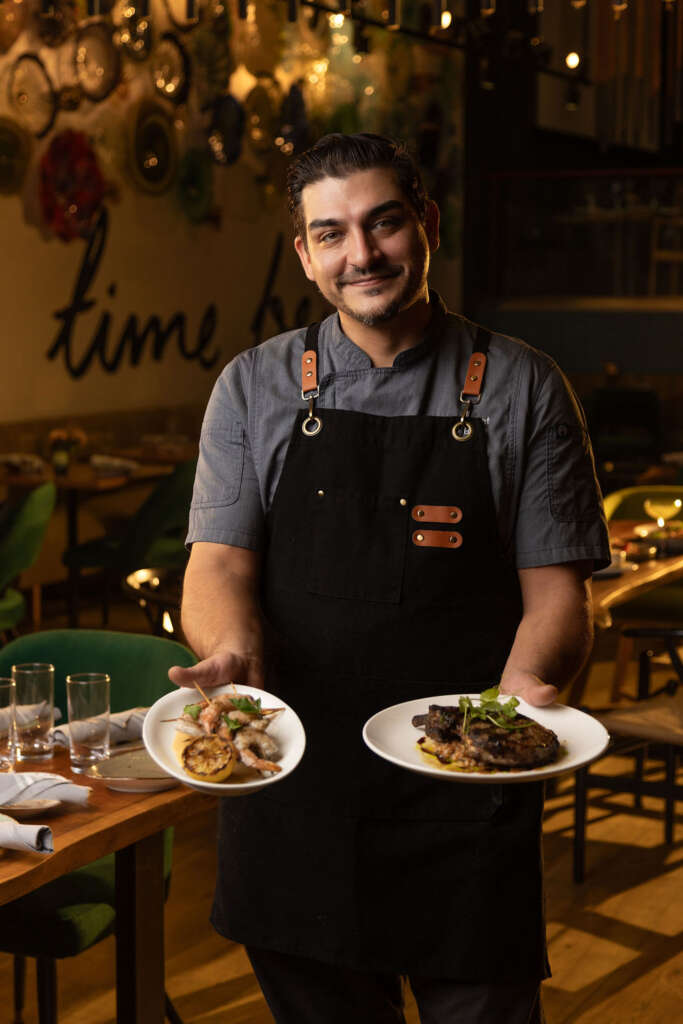
By Dathan Kazsuk | Since stepping in as executive chef at Vidrio, Roberto Barth has brought a quietly confident, deeply Mediterranean approach to the restaurant.
When a chef talks more about olive oil than ego, you know you’re in the right kitchen. Since stepping in as executive chef at Vidrio, Roberto Barth has brought a quietly confident, deeply Mediterranean approach to a restaurant already known for its bold flavors and dramatic plates. With more than two decades in kitchens across the Southeast—and time spent working alongside James Beard–recognized chefs and Certified Master Chefs—Barth isn’t interested in chasing trends or cooking for the camera. He’s interested in craft, clarity, and food that still makes sense ten years from now.
At Vidrio, that philosophy shows up in everything from carefully sourced Greek olive oil to a dessert he’s been refining for nearly a decade. For our Kitchen Confidential series, we talked with Barth about ingredients he obsesses over, the mistakes home cooks make, why restraint can be risky, and how food—at its best—creates something bigger than a meal.
What ingredient are you obsessed with right now, and how are you using it on the menu?
Right now, I’m obsessed with sourcing exceptional extra-virgin olive oil. At Vidrio, olive oil isn’t just a finishing touch—it’s a foundation. Because the ownership is Greek, we naturally lean toward high-quality Greek oils, specifically cold-pressed and carefully filtered. Filtration matters more than most people realize—it affects clarity, bitterness, and how the oil behaves on the plate.
We’ve also just started preserving our own lemons in-house. They’re not on the menu yet, but they will be. Preserved lemons are essential to Mediterranean cooking—they bring depth, salinity, and a bright citrus punch that transforms sauces, vegetables, and seafood.
What’s a food trend you wish Raleigh would embrace—and one you wish would disappear?
I’m still new to Raleigh, so I try not to rush to judgment. Honestly, I don’t chase trends. I’m more interested in craft, sourcing, and whether something actually tastes good ten years from now—not just whether it photographs well today.
What’s the biggest mistake home cooks make when trying to recreate restaurant-level dishes?
Context. Many recipes online come from very specific regions, climates, and supply chains. When you try to recreate them without adapting to your local ingredients, something’s always off.
The other piece is understanding why something works. Cooking is chemistry and physics—heat transfer, emulsification, and seasoning. Once you understand the science, consistency follows. I’m a visual learner, so I gravitate toward resources like “Chef’s Table” and “The Mind of a Chef,” and platforms like Gronda, where Michelin-level chefs show their process, not just the final dish.
How has Raleigh’s dining scene changed since you first started cooking here?
I’m still learning the city, so I’m focused more on contributing to the scene than critiquing it. Raleigh has a lot of energy and curiosity, which is exciting for a chef.
Which dish on your current menu best reflects your culinary philosophy?
The chocolate orb. It’s a dessert I’ve carried with me for nearly a decade. I’ve competed with it, refined it, and rebuilt it countless times—including serving it for Joseph Decker, one of the country’s few Certified Master Pastry Chefs.
At Vidrio, I worked on its latest iteration with our pastry chef. What I love most is the name—we didn’t overcomplicate it. It’s not a bombe or a mousse. It’s just a Chocolate Orb. There’s a little mystery there.
That’s my philosophy at Vidrio: intrigue without intimidation, beautiful flavors, and respect for great ingredients.
On the savory side, I’m also reworking the bar menu. Dishes like shrimp saganaki—layered with North African spice influences, Greek island tradition, and harissa heat—carry my signature.
We’re also developing Moroccan beef sliders with what we call a Mediterranean XO, or “Red Sea” sauce. It’s our version of ketchup—deep, savory, and unmistakably Vidrio.
What’s the biggest risk you’ve taken on a menu—and did it pay off?
Reducing the number of components on a plate and letting restraint lead. In an era of maximalism, simplicity can feel vulnerable. But guests respond when food feels intentional instead of overworked.
Which chef or restaurant—locally or nationally—inspires your work right now, and why?
José Andrés continues to inspire me with how he honors Mediterranean tradition while balancing innovation, purpose, and leadership. His work shows that great cooking isn’t just about technique—it’s about responsibility, humanity, and the ability to create real connection beyond the plate.
What’s the passion project you’re still dreaming of? (e.g., a new restaurant concept, a cookbook, a non-profit, etc.)
My long-term dream is to build a culinary education platform that integrates technology in a meaningful way. AI, augmented reality, and robotics have the potential to support chefs, preserve craft, and expand access to knowledge.
After COVID, the education gap in kitchens became impossible to ignore. Used with intention, technology can level the playing field and help shape a stronger future for the industry.
What was the single hardest moment or biggest “failure” in your career, and what did you learn from it that you still use today?
I became an executive chef at 22—before culinary school. I rose fast, and I failed fast. I didn’t yet have the foundation to support the title.
Culinary school slowed me down in the best way. I studied history, technique, and culture. I learned that mastery isn’t something you arrive at—it’s something you build over a lifetime. That mindset still shapes how I cook, lead, and learn today.
Whether it’s a chocolate orb built on years of refinement or a shrimp saganaki layered with Mediterranean and North African influence, his food is about intention more than spectacle. That same mindset carries into how he talks about the future, where technology, education, and hospitality all intersect in the kitchen.