

By Dathan Kazsuk
Patrick Wolf was in England when we spoke by Zoom. I was in my office in Raleigh, which is about as glamorous as it sounds unless you consider a desk, a laptop, and the faint glow of deadlines to be part of the mystic arts.

Still, it turned into one of those rare conversations that felt less like a standard pre-tour interview and more like stepping into the strange, beautiful architecture of an artist’s mind. Wolf—British singer, songwriter, multi-instrumentalist, and longtime art-pop shape-shifter—is preparing to return to the U.S. for his 2026 Tour Of The Beast, which begins June 5 at DC9 in Washington, D.C., stops in Raleigh at The Pour House Music Hall & Record Shop on June 7, and continues across the country before closing June 30 in Los Angeles.
The tour follows Crying the Neck, Wolf’s seventh album and his first full-length release in 13 years, a work rooted in English and Celtic folklore, grief, recovery, and the strange seasonal rituals that survive in the corners of memory.
After we spoke, I spent time with the record and found myself hearing traces of folk ritual, chamber music, gothic art-pop, and, somewhere in the shadows, the dark ambient wave atmosphere of Black Tape for a Blue Girl. Not a direct comparison, exactly. More like a distant cousin wandering across the moors with a violin, a candle, and a very complicated relationship with mortality.
When I asked Wolf whether this tour feels like a comeback, he gently pushed back on the word. Comeback, after all, suggests an artist trying to resurrect some old version of himself from the crypt. Wolf seems far more interested in introducing the person he is now.
“I don’t really come back because I’m always bringing something new,” Wolf said. “I’m never trying to resuscitate anything.”
For Wolf, the current phase is less about nostalgia than rebuilding. After a long period away from the machinery of the music business, he has found himself reconnecting not only with longtime listeners but also with a new generation that discovered his music after the first wave of his career had already passed.
“When I came on my tour last year, I didn’t quite realize how my audience had changed,” Wolf said. “A lot of the people coming to my shows had discovered me in college and were too young the first time around. Now they’re grown up. They go to shows. They’re seeing me for the first time.”
That makes the experience feel, in his words, like a reintroduction. Or maybe even an introduction, period.
For listeners who have never fallen into Wolf’s world before, it is not an easy one to pin to a genre board with thumbtacks. His music moves through folk, classical, electronic textures, theatrical pop, and something closer to myth-making. There are songs that feel like they were dug out of the earth, others that sound like they escaped from a candlelit cabaret on the edge of a haunted forest.
So I asked him what he hopes a first-time listener walking into The Pour House in Raleigh takes away from the show.
“I hope that it feels a bit like a mirror,” Wolf said. “What I really try and do—my storytelling, my metaphor—is hopefully make people feel less alone in this world.”
That idea came up often in our conversation: music as a form of belonging. Not in a syrupy, inspirational-poster sort of way. More like a flare sent up in a dark field.
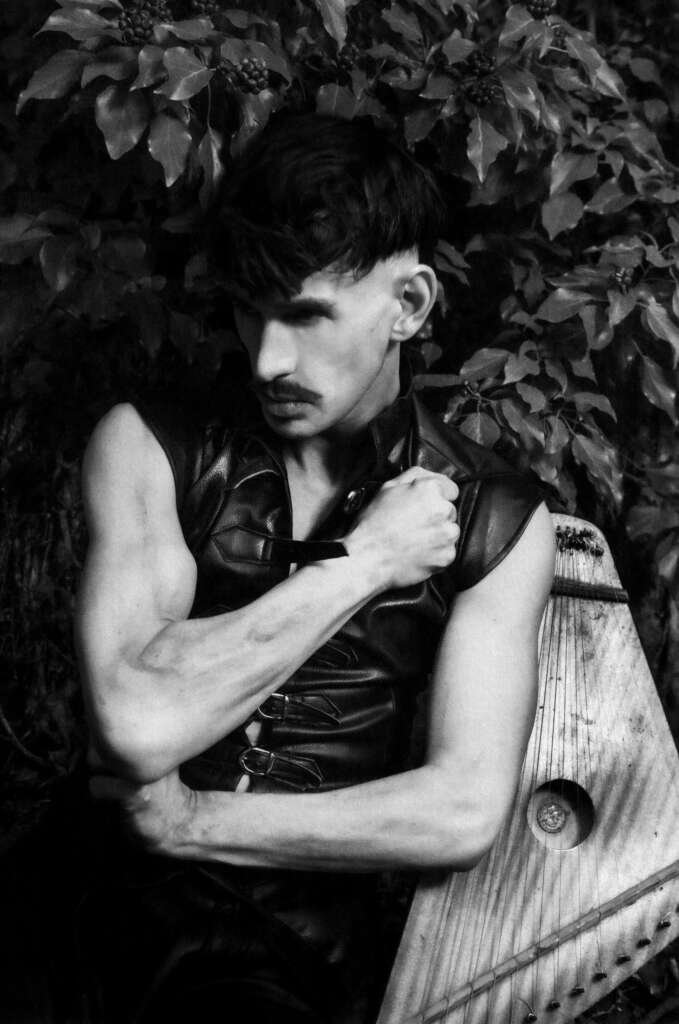
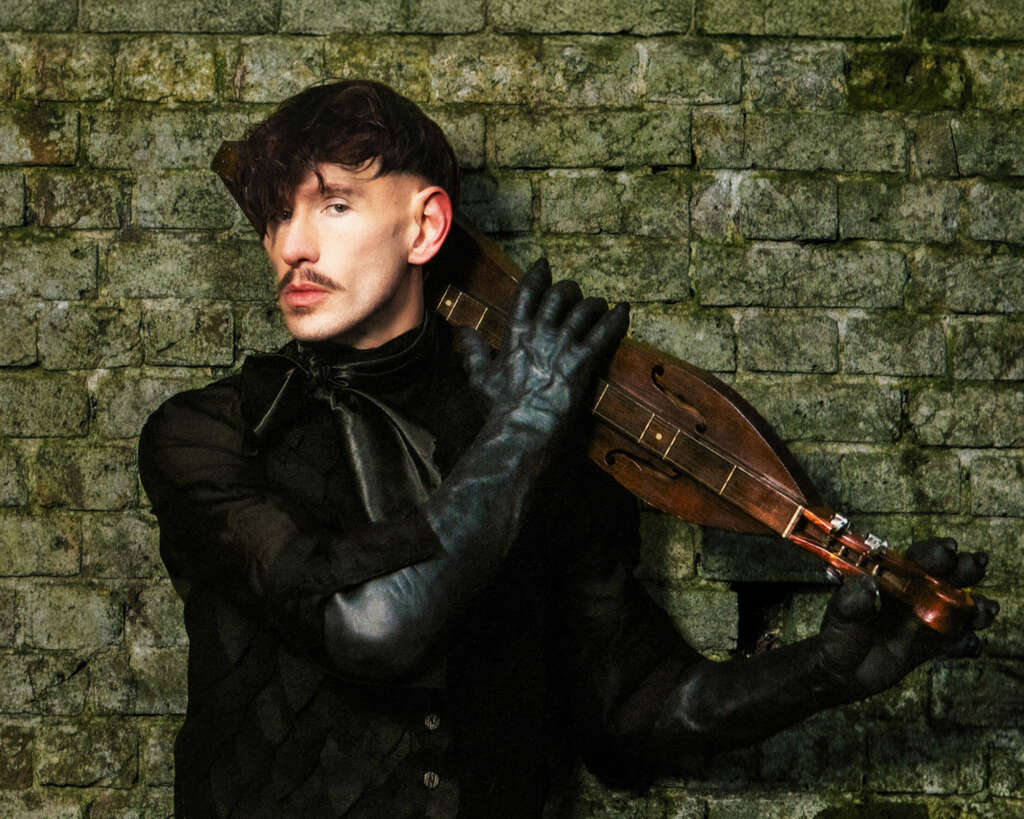
That beauty comes with a lot of tools. Wolf is known for his ability to move between instruments—piano, viola, harp, lyre, dulcimer, guitar, electronics—and his live show is built around that restless, theatrical range. On this tour, he is performing solo, which, in his case, does not mean a guy with an acoustic guitar and a stool. It means one person surrounded by a small kingdom of instruments and enough emotional voltage to keep the room awake.
“It’s my one-man show,” he said. “It’s like two hours long, and I think there are seven or eight instruments on stage.”
When I asked how a Patrick Wolf song begins—with lyrics, music, image, or instrument—he described a process that has become almost instinctive after a lifetime of writing, producing, and performing his own work.
“I produce all my own work,” Wolf said. “Everything now has its own infrastructure subconsciously. I start collecting instruments from there,” he said. “A lyric might come first and make me think of a certain instrument I have in my studio.”
THE NEW ALBUM
Crying the Neck may be his most personal world yet.
The album’s title comes from an old harvest tradition in which the final sheaf of corn or wheat was held up and cried out across the field. For Wolf, that ritual became a way into grief, particularly after the death of his mother.
“My mother had passed, and I had always thought that if any of my parents died, then they deserve an album,” Wolf said. “At least.”
He described the record as a harvest album about grief, recovery, and losing a parent. The timing of his mother’s death and birthday coincided with the ancient festival that inspired the title, creating a metaphor in which harvest becomes both an ending and an offering.
The album also marks a hard-won return after a long and difficult stretch in his life. Wolf spoke openly about addiction, recovery, and the slow rebuilding of the creative self.
“I ran into addiction through drugs and alcohol, and that completely brought my creative brain to a halt,” he said. “It took a lot of repairing.”
He described finishing the final mix of Crying the Neck in London and breaking down afterward on the train platform, overwhelmed by the realization that he had done something he had been trying to do for more than a decade: become a working artist again.
“The first thing I think anyone needs in art is the confidence to execute,” Wolf said. “First of all, make it. Second of all, step up and say, does anyone want to see that?”
That honesty is part of what makes Crying the Neck land with weight. It is not a record using grief as decoration. It is grief as geography. Grief as weather. Grief is an old ritual still echoing in the field.
THE INSPIRATIONS
The conversation also turned to the artistic figures who have crossed his path, including Patti Smith, Tilda Swinton, and Yoko Ono. For Wolf, Smith holds a particularly important place.
“Patti, I would say, is the biggest awe-stranger for me in my life,” he said.
They met around the time of his fourth album, when Wolf said he was being treated by the music industry as trouble—someone who did not fit cleanly anywhere. Smith, he said, saw beyond that.
“She saw the poet and the musician in me,” Wolf said.
Swinton, meanwhile, is executive producer of an upcoming feature film about Wolf’s life and also serves as narrator. Wolf spoke of her with obvious admiration, noting how her performance in Orlando had a profound impact on him.
“Tilda in Orlando was life-changing for me,” he said.
As for Yoko Ono, Wolf recalled being asked to sing one of John Lennon’s songs as part of a reimagining of Double Fantasy. He ended up contributing to several pieces, including one with Smith.
“She sent me a Christmas card,” Wolf said, still sounding slightly amused by the surreal sweetness of it.
THE RETURN TO NORTH CAROLINA
When Wolf returns to North Carolina in June, it will mark his first Raleigh-area performance in many years. He remembered being in the state around his 27th birthday, somewhere near a Quiznos, a hearing aid shop, and an antique place in Denton. It is exactly the kind of strange travel detail that sticks in a touring musician’s mind: not the grand landmark, but the odd little strip of America where memory decides to set up camp.
This tour, he said, is designed to let him experience the country rather than simply rush through it. He is driving himself across America in a rented minivan.
“I’m the only crew,” he said. “It’s a very holistic way to tour. A very writer’s way of seeing things.”
He even suggested that the next album may become an observation of America, shaped by what he sees along the road.
For now, though, the focus is on the stage. Wolf said the Raleigh show will follow an emotional arc. The songs may open doors into grief and loss, but he does not want to leave everyone standing there in the dark, holding a candle and wondering what happened to their Sunday night.
“If I’m going to make people cry,” Wolf said, “then I feel guilty not trying to help them dance by the end of the night as well.”
For those walking into The Pour House on June 7, expect something intimate, strange, deeply personal, and hard to categorize—the sort of performance that does not simply ask you to listen but invites you to enter the room with your ghosts, your scars, and whatever beauty you’ve managed to keep alive.
Patrick Wolf performs Sunday, June 7, at The Pour House Music Hall & Record Shop in Raleigh as part of his 2026 Tour Of The Beast.
For more Midtown features on music and the arts, click here.