WORKING FITNESS IN
On a warm fall afternoon, Koutroumpis has his fitness walking class ready to move out. The students are dressed in shorts and T-shirts, and most of them seem purposeful as they head outside for a 2-mile walk that will be followed by 30 pushups, 30 crunches and 30 squats.
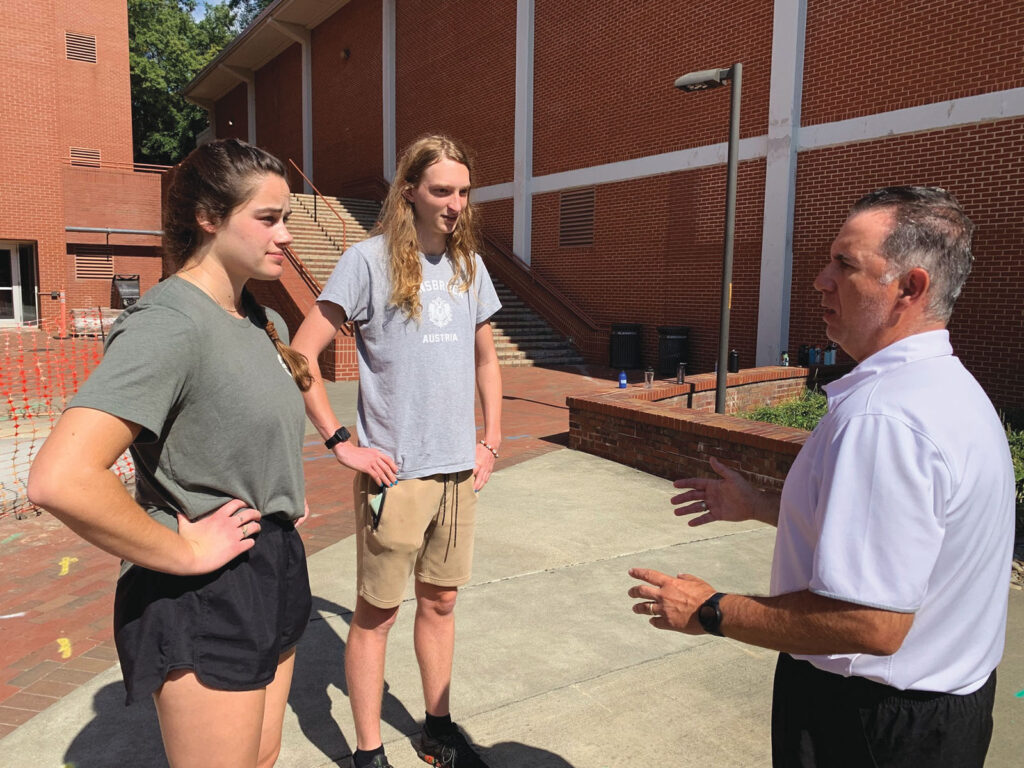
Shay Parton, a junior from Rutherford County, has used the fitness walking classes to rekindle the athleticism she relied on as a varsity athlete in high school. “I have loved this class so far,” she says. “The amount of time we’re walking has been almost an opening back to my soccer days, because we’re working on cardio and muscle endurance.”
Some students enroll in the 100-level courses just to check a box to meet the credit requirements. That’s what Luke Jackson thought when he signed up for fitness walking, but the junior transfer from Johnston Community College quickly had a change of heart.
“I did cross country in high school and I’ve been doing it sort of on-and-off on my own, but it’s hard to keep it up,” Jackson says. “So if I’m going to show up here, I should take it seriously. It’s another way of exercising to get your cardio in. That’s why I like this; it’s sort of lower stress.”
The benefits of physical activity on campus go beyond maintaining a level of fitness, a lesson that is reinforced in the classroom. Students learn that the stress response affects them psychologically, physiologically and hormonally. “Academic rigor at the collegiate level is high,” Koutroumpis says. “A lot of the students don’t have the ability to manage those aspects of their life if they’re not being paid attention to. And all the research backs it up—it’s not just talk. A little bit of movement and activity makes a difference … The benefits are a stronger, more efficient heart rate, cardio-respiratory endurance and muscle endurance. They’re all things that are needed to manage and combat stress levels and combat cardiovascular disease and illnesses.”
Parton acknowledges that the exercise class helps her deal with the demands of her academic life. “It has made things a lot more manageable,” she says. “Something that seems so simple, like doing the 30–30–30s after a mile or
2 miles of very fast walking, can still be so difficult. It’s nice to know that I can apply that into my everyday life. If I’m studying and know I need to get my heart beating faster, I can apply those things.”
Beyond the preliminary classes are a wide variety of sports and exercise options, such as rock climbing, tennis, racquetball and weight training. Students are expected to build on the basic competencies of a sport, even if they have some experience in the activity from their childhood. “Just because they played soccer doesn’t mean they can take 10 penalty kicks and hit the goal on all of them,” Koutroumpis says.