Skip to content Skip to sidebar Skip to footer

Talking Shop with Figulina’s Chef David Ellis

| By Dathan Kazsuk |

I’m not usually the guy who volunteers to get his hands dirty with hot dough on a weekday, and luckily, I didn’t have to. But I did get to watch chef David Ellis effortlessly shape orecchiette, or as he puts it, “little ears.” 

We’re standing at the pasta counter inside Figulina, his breakout Italian-ish restaurant in Raleigh that’s managed to fuse old-world technique with Southern charm—and is now riding high on a James Beard nomination for Best New Restaurant.

“I actually taught a pasta class here yesterday,” he says, forming the dough with the kind of ease that only comes from muscle memory. “It was a bit messy—people were flinging flour everywhere—but they loved it.”

Today, Ellis was making hot water dough. No eggs. “This is a good one for people to do at home,” he tells me. “No machine necessary. Just your hands and maybe a little patience.” He used durum flour to shape the orecchiette, using those perfect ridges to cling to the sauce.

I learned the hard way the last time, making dough for traditional Hungarian pastries—and haven’t made it again—but with some tips from Ellis, it might be time this holiday to give it another shot.

The restaurant’s name, Figulina, isn’t just a random Italian-sounding moniker. It has roots—both personal and historical. “My wife, Sam, came up with it,” Ellis says, while kneading the dough into that signature Play-Doh texture. “I’m originally from Stoke-on-Trent in England, which was known for pottery. She found this Latin word, figula, which means ‘to mold’ or ‘to shape.’ And from that came ‘figulina’—meaning ‘potter’s workshop.’”
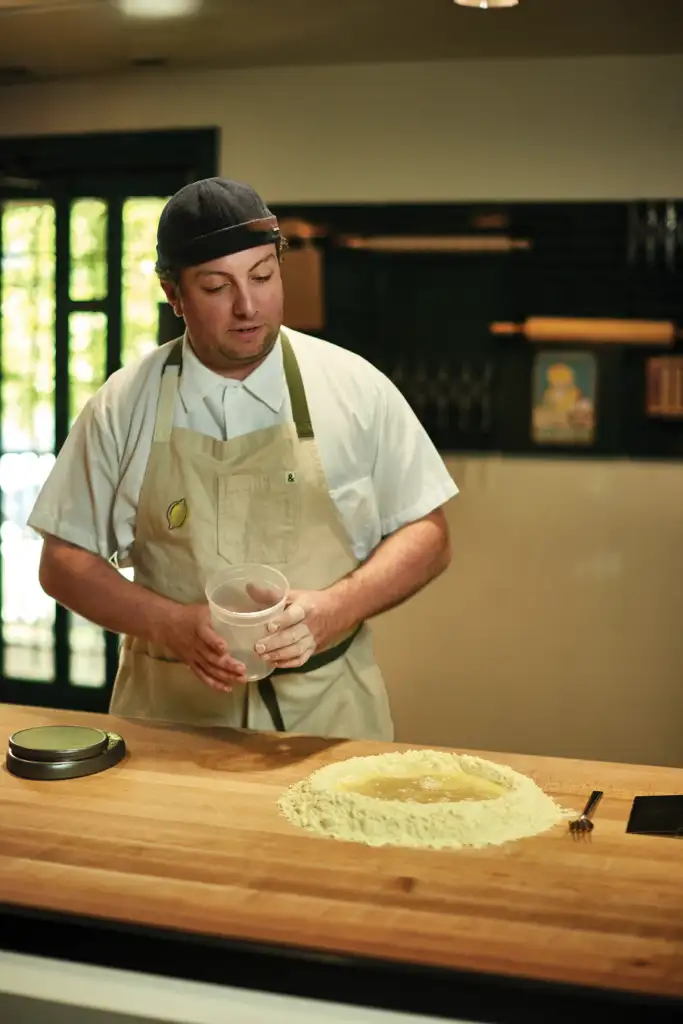
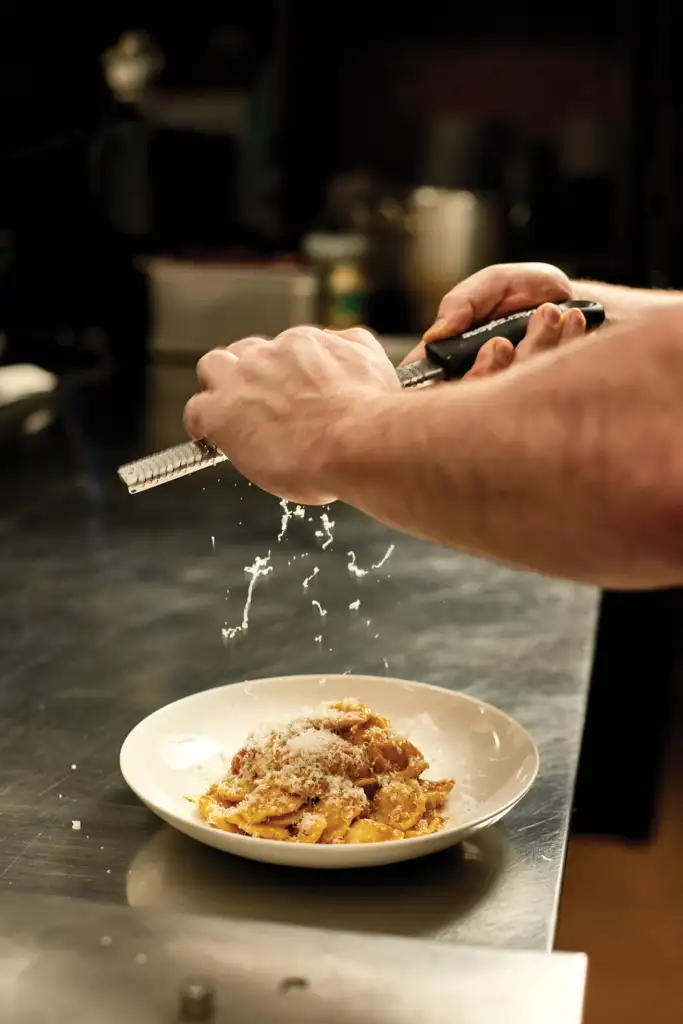
Chef David Ellis creates pasta with practiced ease, forming the dough with warm water and durum flour, shaping the pasta using a bench scraper, and topping with grated cheese. Photo by Jessica Bratton.

It’s poetic, really. Pasta as sculpture. Plates as pottery. I get it! And Sam’s hand is everywhere in this space—designing the mural, managing social media, even inspiring tattoos. Yes, people have gotten her artwork inked on their bodies. “Someone got the two fish with noodles from our menu tattooed,” he laughs. I think they were angling for a discount.

Before we moved into the kitchen, I watched him bring the dough to life—cutting it, rolling it into tiny logs, then using a bench scraper and his thumb to shape each individual piece. “There might be 30 pieces on a plate,” he explains, “and we’ll do 30 of those plates in a night. That’s 900 little ears. All made by hand.”

That kind of commitment isn’t new to Ellis. Before opening Figulina, he spent time under the culinary powerhouse that is Ashley Christensen at Poole’s Diner. “Ashley’s a force,” he says. “Being around someone like that—who’s constantly pushing boundaries—it makes you want to work harder. Be better.”

That same work ethic has followed him into Figulina’s kitchen. The James Beard nomination? It was a surprise. “I was in the kitchen, just prepping like any other day,” he says. “Then my PR person called. I had no idea. I wasn’t thinking about awards—I was just focused on the food.”
Introspective singer-songwriter Sunny War hails from Nashville. Photo by Joshua Black Wilkins.

Food speaks multiple languages. And Figulina leans Italian in structure, but it’s also unapologetically Southern. Blistered tomatoes, local okra, smoked pork—it all finds its way into dishes that are equal parts comfort and craft. “We try to use what’s around us,” Ellis says. “Italian technique with Southern ingredients. I mean, back in Europe, I didn’t use corn or okra—but here? It just works.”

He’s even slipping in some of his British roots. “When we first opened, I had a few small plates that leaned English—soda bread, piccalilli, things like that,” he recalls. “These days, it’s more in the brunch menu. But I want to bring more of that back.”

When we sit down to sample his creation, Ellis sets down a plate that hits the sweet spot between rustic and soul—his hand-rolled orecchiette dressed in vibrant pesto, blistered cherry tomatoes, and fresh grated cheese. It’s warm, comforting, and quietly refined. As I take a bite, I can’t help but feel a little déjà vu. I think of this building’s past life as Humble Pie, where I once sat just a few feet away eating gnocchi.

This space has seen quite the transformation. From 1990 until its closure in 2023, it was home to Humble Pie. Before that, it served a more utilitarian purpose as a tile distributing company. Now, with Figulina and chef Ellis at the helm, this historic building is entering its new chapter—one I hope continues for years.

And as for the future? Ellis doesn’t seem too concerned about chasing those accolades. “The goal is to make good food, stay curious, and have fun,” he says.

After all, what’s more satisfying than shaping something from nothing—pasta,  a restaurant, or dreams?  

CHEF ELLIS’ ORECHIETTE RECIPE
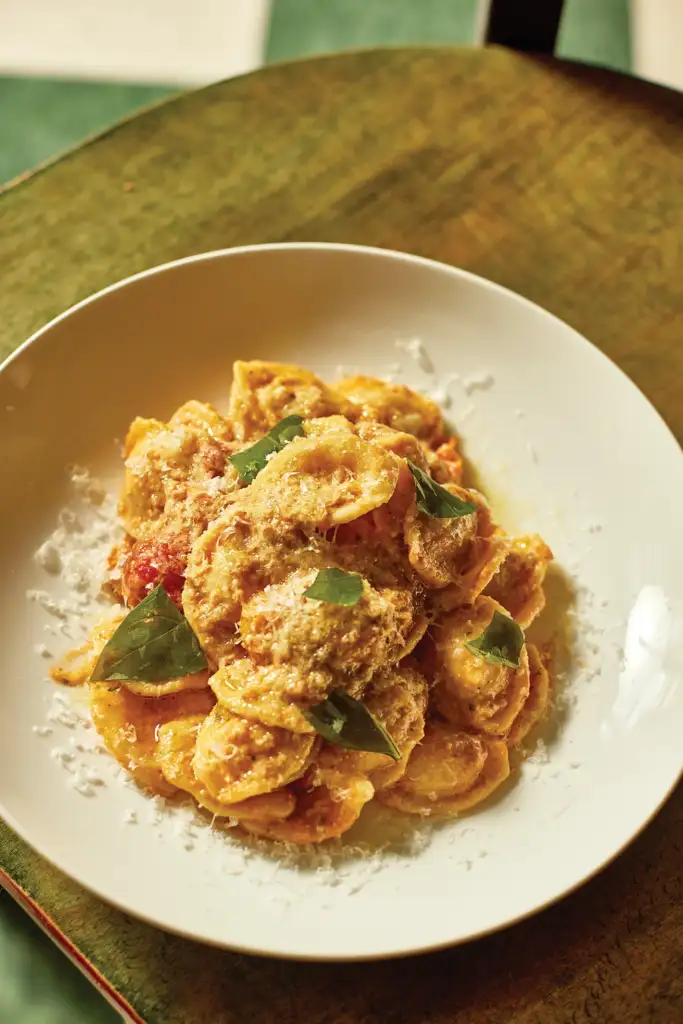
All pasta is made fresh daily at FIgulina. Photo by Jessica Bratton.

Weigh out 400 grams of durum flour and 200 grams of warm water. Bring the dough together in a bowl by making a well in the middle of the flour, then add the water.

With a fork, start mixing the water, bringing in little bits of flour from around the edges and mixing into the middle. Once it gets really thick in the middle, start mixing it all together, cutting the dough into little bits with a knife. Once it is an even, shaggy mix, ball it up by squeezing it together.

Knead for a few minutes until it has a dimpled texture. Continue kneading until you have a nice, smooth ball, another three or so minutes. Wrap tightly and rest for at least 30 minutes, but preferably 1 hour.

Slice a piece of the dough ball and, using your hands, roll out into a long strand on a chopping board. Once it is the width of a big finger, slice it into 2-centimeter pieces. Press down and drag a knife firmly across the wooden board. It will curl up on itself, then turn it inside out over your finger. Take some time to experiment with different pressures when dragging; you need to press more firmly than you think. If it isn’t turning inside out well, it’s too thick, and you need to press harder.

Place the finished orecchiette on a baking tray dusted with coarse semolina.

Pesto Trapanese

50g whole almonds
1 garlic clove
50g olive oil
5g basil
15g parsley
250g cherry tomato
115g Roma tomato
60g pecorino romano
3g sea salt

Toast the almonds at 350°F for 7–10 minutes, until golden brown.

Blend the almonds and oil until a smooth puree forms, then add the herbs and blend until smooth.

Add the remaining ingredients and puree until smooth.

Dish Pickup

Serves 4

250g cherry tomato
1 Tbsp olive oil
Pesto trapanese
1lb orecchiette
Pecorino Romano
Fresh basil

Preheat a saucepan over medium heat.

Add the olive oil and the cherry tomatoes. Season the tomatoes with sea salt and cook until the skins begin to blister and the tomato starts to break down. At this point, add the pesto trapanese and turn the heat down to low.

Drop the orecchiette into a pot of well-salted boiling water and cook for 4 minutes or until they have reached your desired texture.

Transfer the cooked orecchiette to the pan with the tomatoes and pesto trapanese, along with a little of the pasta water. Toss the orecchiette with the sauce until the sauce coats and clings to the orecchiette.

Plate the pasta in a bowl and finish with a sprinkle of grated pecorino Romano and torn.  

Sign up for our weekly newsletter, Talk of the Triangle!

© 2008-2025 Midtown magazine, LLC. All rights reserved. Copyright applies to all pages on this website. | Privacy Policy

| By Dathan Kazsuk |

I’m not usually the guy who volunteers to get his hands dirty with hot dough on a weekday, and luckily, I didn’t have to. But I did get to watch chef David Ellis effortlessly shape orecchiette, or as he puts it, “little ears.” 

We’re standing at the pasta counter inside Figulina, his breakout Italian-ish restaurant in Raleigh that’s managed to fuse old-world technique with Southern charm—and is now riding high on a James Beard nomination for Best New Restaurant.

“I actually taught a pasta class here yesterday,” he says, forming the dough with the kind of ease that only comes from muscle memory. “It was a bit messy—people were flinging flour everywhere—but they loved it.”

Today, Ellis was making hot water dough. No eggs. “This is a good one for people to do at home,” he tells me. “No machine necessary. Just your hands and maybe a little patience.” He used durum flour to shape the orecchiette, using those perfect ridges to cling to the sauce.

I learned the hard way the last time, making dough for traditional Hungarian pastries—and haven’t made it again—but with some tips from Ellis, it might be time this holiday to give it another shot.

The restaurant’s name, Figulina, isn’t just a random Italian-sounding moniker. It has roots—both personal and historical. “My wife, Sam, came up with it,” Ellis says, while kneading the dough into that signature Play-Doh texture. “I’m originally from Stoke-on-Trent in England, which was known for pottery. She found this Latin word, figula, which means ‘to mold’ or ‘to shape.’ And from that came ‘figulina’—meaning ‘potter’s workshop.’”

Chef David Ellis creates pasta with practiced ease, forming the dough with warm water and durum flour, shaping the pasta using a bench scraper, and topping with grated cheese. Photo by Jessica Bratton.

It’s poetic, really. Pasta as sculpture. Plates as pottery. I get it! And Sam’s hand is everywhere in this space—designing the mural, managing social media, even inspiring tattoos. Yes, people have gotten her artwork inked on their bodies. “Someone got the two fish with noodles from our menu tattooed,” he laughs. I think they were angling for a discount.

Before we moved into the kitchen, I watched him bring the dough to life—cutting it, rolling it into tiny logs, then using a bench scraper and his thumb to shape each individual piece. “There might be 30 pieces on a plate,” he explains, “and we’ll do 30 of those plates in a night. That’s 900 little ears. All made by hand.”

That kind of commitment isn’t new to Ellis. Before opening Figulina, he spent time under the culinary powerhouse that is Ashley Christensen at Poole’s Diner. “Ashley’s a force,” he says. “Being around someone like that—who’s constantly pushing boundaries—it makes you want to work harder. Be better.”

That same work ethic has followed him into Figulina’s kitchen. The James Beard nomination? It was a surprise. “I was in the kitchen, just prepping like any other day,” he says. “Then my PR person called. I had no idea. I wasn’t thinking about awards—I was just focused on the food.”

Introspective singer-songwriter Sunny War hails from Nashville. Photo by Joshua Black Wilkins.

Food speaks multiple languages. And Figulina leans Italian in structure, but it’s also unapologetically Southern. Blistered tomatoes, local okra, smoked pork—it all finds its way into dishes that are equal parts comfort and craft. “We try to use what’s around us,” Ellis says. “Italian technique with Southern ingredients. I mean, back in Europe, I didn’t use corn or okra—but here? It just works.”

He’s even slipping in some of his British roots. “When we first opened, I had a few small plates that leaned English—soda bread, piccalilli, things like that,” he recalls. “These days, it’s more in the brunch menu. But I want to bring more of that back.”

When we sit down to sample his creation, Ellis sets down a plate that hits the sweet spot between rustic and soul—his hand-rolled orecchiette dressed in vibrant pesto, blistered cherry tomatoes, and fresh grated cheese. It’s warm, comforting, and quietly refined. As I take a bite, I can’t help but feel a little déjà vu. I think of this building’s past life as Humble Pie, where I once sat just a few feet away eating gnocchi.

This space has seen quite the transformation. From 1990 until its closure in 2023, it was home to Humble Pie. Before that, it served a more utilitarian purpose as a tile distributing company. Now, with Figulina and chef Ellis at the helm, this historic building is entering its new chapter—one I hope continues for years.

And as for the future? Ellis doesn’t seem too concerned about chasing those accolades. “The goal is to make good food, stay curious, and have fun,” he says.

After all, what’s more satisfying than shaping something from nothing—pasta,  a restaurant, or dreams?  

CHEF ELLIS’ ORECHIETTE RECIPE

All pasta is made fresh daily at FIgulina. Photo by Jessica Bratton.

Weigh out 400 grams of durum flour and 200 grams of warm water. Bring the dough together in a bowl by making a well in the middle of the flour, then add the water.

With a fork, start mixing the water, bringing in little bits of flour from around the edges and mixing into the middle. Once it gets really thick in the middle, start mixing it all together, cutting the dough into little bits with a knife. Once it is an even, shaggy mix, ball it up by squeezing it together.

Knead for a few minutes until it has a dimpled texture. Continue kneading until you have a nice, smooth ball, another three or so minutes. Wrap tightly and rest for at least 30 minutes, but preferably 1 hour.

Slice a piece of the dough ball and, using your hands, roll out into a long strand on a chopping board. Once it is the width of a big finger, slice it into 2-centimeter pieces. Press down and drag a knife firmly across the wooden board. It will curl up on itself, then turn it inside out over your finger. Take some time to experiment with different pressures when dragging; you need to press more firmly than you think. If it isn’t turning inside out well, it’s too thick, and you need to press harder.

Place the finished orecchiette on a baking tray dusted with coarse semolina.

Pesto Trapanese

50g whole almonds
1 garlic clove
50g olive oil
5g basil
15g parsley
250g cherry tomato
115g Roma tomato
60g pecorino romano
3g sea salt

Toast the almonds at 350°F for 7–10 minutes, until golden brown.

Blend the almonds and oil until a smooth puree forms, then add the herbs and blend until smooth.

Add the remaining ingredients and puree until smooth.

Dish Pickup

Serves 4

250g cherry tomato
1 Tbsp olive oil
Pesto trapanese
1lb orecchiette
Pecorino Romano
Fresh basil

Preheat a saucepan over medium heat.

Add the olive oil and the cherry tomatoes. Season the tomatoes with sea salt and cook until the skins begin to blister and the tomato starts to break down. At this point, add the pesto trapanese and turn the heat down to low.

Drop the orecchiette into a pot of well-salted boiling water and cook for 4 minutes or until they have reached your desired texture.

Transfer the cooked orecchiette to the pan with the tomatoes and pesto trapanese, along with a little of the pasta water. Toss the orecchiette with the sauce until the sauce coats and clings to the orecchiette.

Plate the pasta in a bowl and finish with a sprinkle of grated pecorino Romano and torn.  

Sign up for our weekly newsletter, Talk of the Triangle!

This Pop-up Is Included in the Theme
Best Choice for Creatives
Purchase Now