By Dathan Kazsuk | Recently named one of the Most Beautiful Restaurants in America, Tamasha, located inside Raleigh’s North Hills, has quickly established itself as a destination.
By Matt Weiss | Somewhere along the way, especially in the U.S., rosé wine became shorthand for sugary, simple, and unserious. A wine for people who do not really…
Recently named one of the “Most Beautiful Restaurants in America,” Tamasha, located inside Raleigh’s North Hills, has quickly established itself as a destination where design, cuisine, and atmosphere move in sync. From the muted glow of the lighting to the deliberate flow of the dining room, every detail feels intentional, composed, and quietly confident.
At the center of that vision is Tina Vora, co-owner and designer, whose background in beauty, fashion, and luxury branding informs every inch of the space. Working alongside her husband and business partner, Mike Kathrani, and in close collaboration with Bhavin Chhatwani, Tamasha’s James Beard–recognized executive chef, Vora approached the restaurant as a complete sensory narrative—one where the room enhances the food, and the food deepens the room.
In the conversation that follows, Vora shares how Tamasha came together—from the emotions she wanted guests to feel upon arrival, to the idea of a “grand performance” guiding the design, and the importance of collaboration between the dining room and the kitchen. It’s a thoughtful look at how design can shape memory, mood, and meaning long after the last plate is cleared.
MIDTOWN: Tamasha has been named one of the “Most Beautiful Restaurants in America.” When you began designing the space, what feeling did you want guests to experience the moment they walked in?
From the outset, Tamasha was envisioned as a destination. One where design, cuisine, and atmosphere exist in complete harmony. I wanted the moment of arrival to feel transportive—almost cinematic, yet composed and intentional. Not loud or overwhelming, but immersive in a way that immediately signals refinement.
When guests walk into Tamasha, there’s a pause, a shift in energy. It’s luxury without excess, confidence without arrogance. A space that doesn’t announce itself, because it doesn’t need to. The room carries warmth, depth, and a quiet power, creating an immediate sense of anticipation, as though something exceptional is about to unfold.
To see that vision recognized so early, right after we opened, has been incredibly meaningful to me. Being acknowledged by the Michelin Guide and Esquire magazine as one of the ‘Best New Restaurants in 2025’, and having Tamasha named one of People magazine’s ‘Most Beautiful Restaurants in America’, was both humbling and deeply rewarding. It affirmed what I believe so strongly—that design isn’t just a backdrop to dining; it’s an essential part of the experience. The space should feel as intentional and memorable as the cuisine itself.
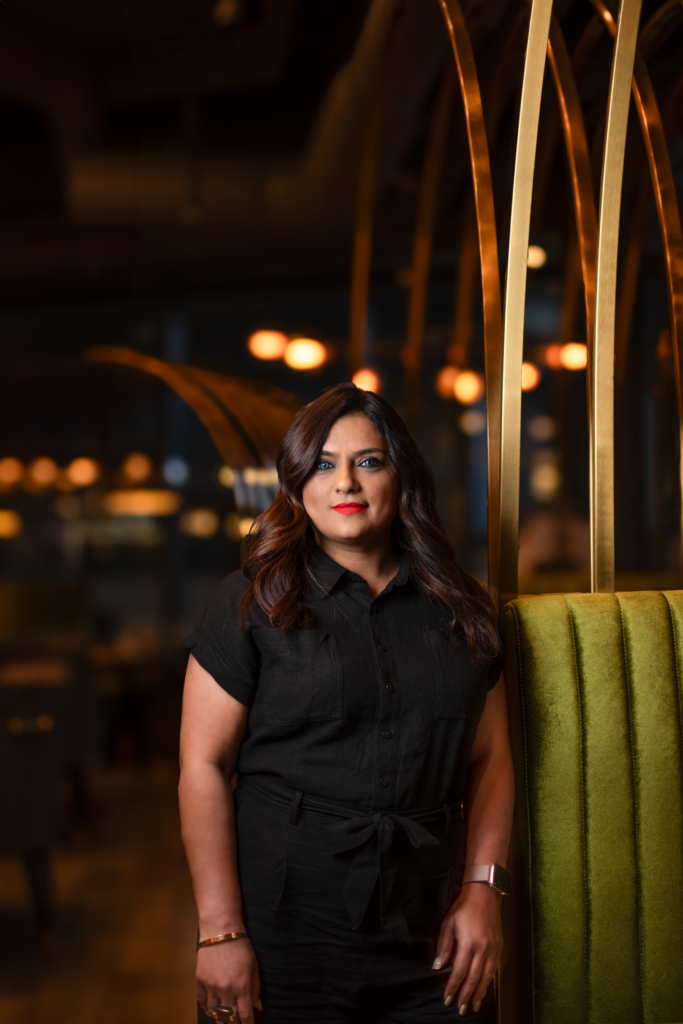
Tina Vora, co-owner and designer of Tamasha. Photo by Harsha Sipani.
The name Tamasha translates to “grand performance.” How did that idea shape your design choices—from lighting and textures to the layout and flow of the room?
At Tamasha, the idea of a “grand performance” isn’t about spectacle, it’s about orchestration. Every element was meticulously curated to play a precise role in the overall experience, creating a rhythm that guides guests through the space.
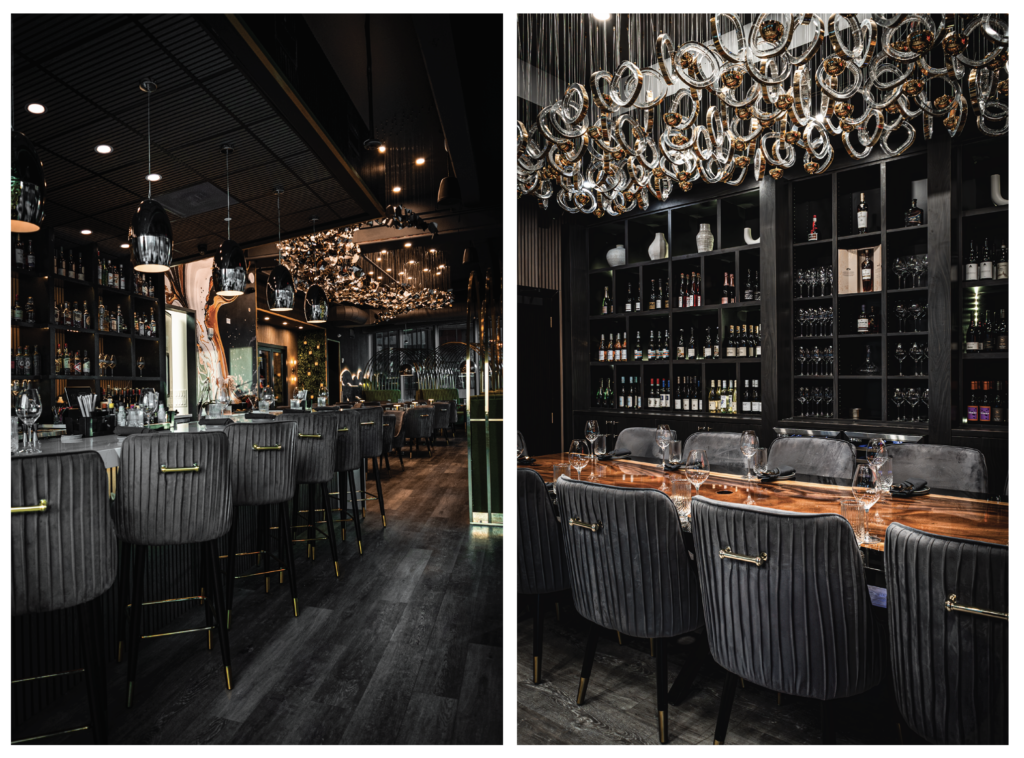
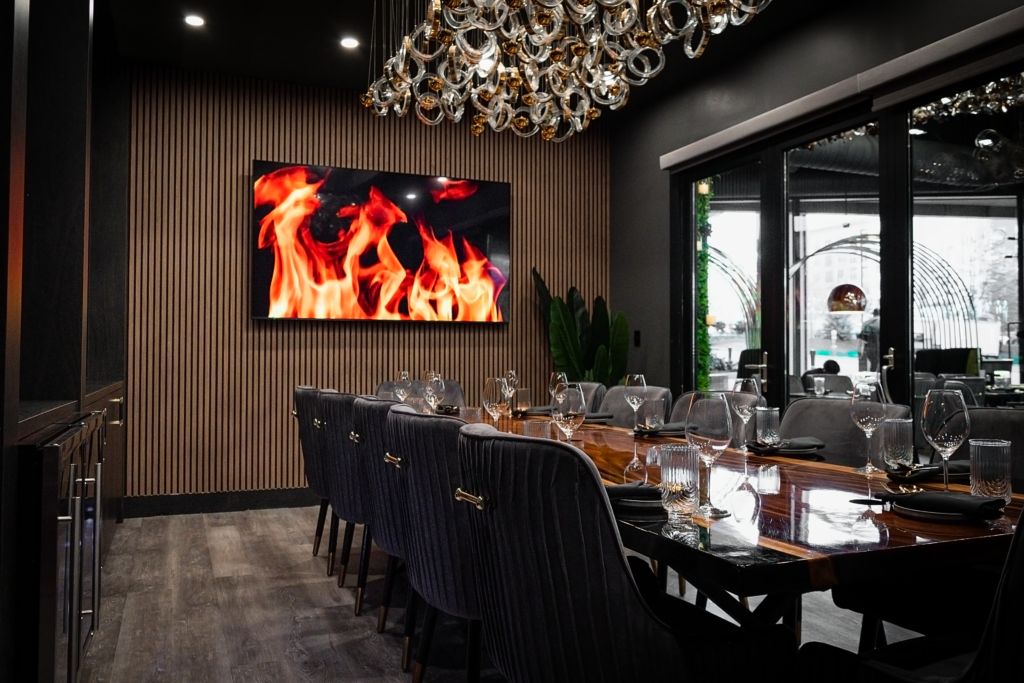
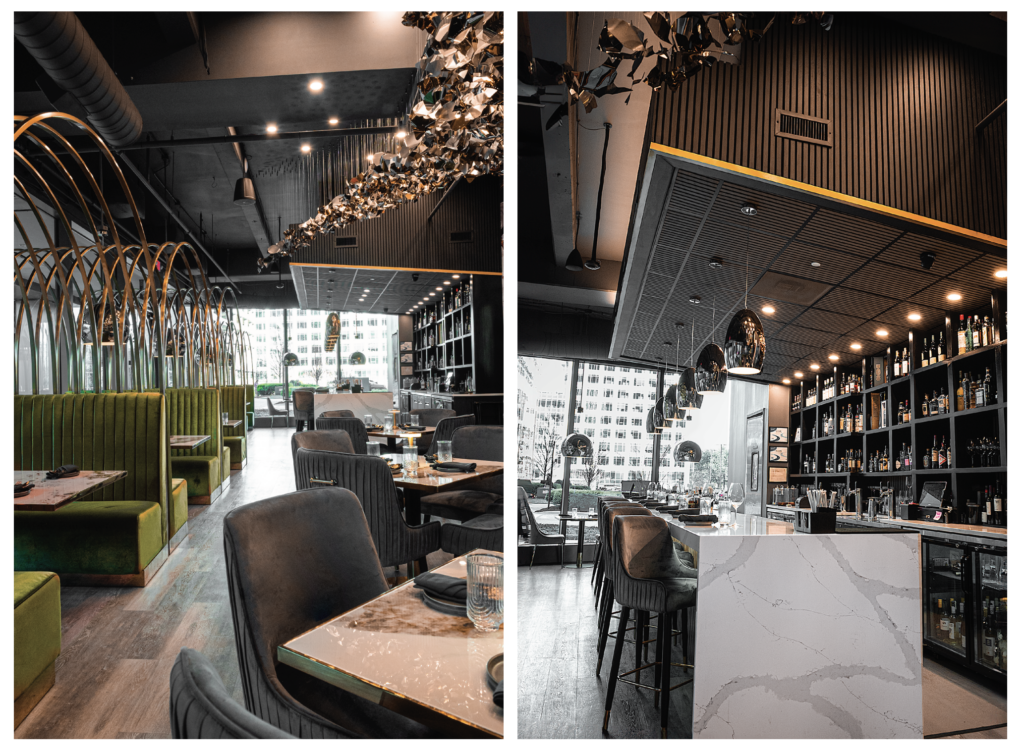
The color palette was chosen with intention. Olive green velvet booths provide privacy and intimacy, while muted gold arches frame each table, allowing guests to feel cocooned yet still connected to the energy of the larger dining room. The tables themselves are expressions of materiality and craft: In the main dining room, a luxurious stone table with natural and abstract veining anchors the space, while in the private dining room, a custom live-edge wood table brings warmth, tactility, and a distinctly personal sense of occasion. Above, custom ceiling sculptures in both the main and private dining areas add sculptural drama and draw the eye upward, reinforcing the layered, immersive nature of the design.
Materials such as velvet, brushed metals, and stone were layered to create depth, texture, and tactile richness, while the lighting evolves throughout the evening, softening as the night unfolds to cultivate intimacy without diminishing the vibrancy of the room.
The layout was carefully choreographed to encourage discovery rather than exposure, balancing moments of quiet intimacy with subtle bursts of drama. Nothing in the space is accidental. Every texture, curve, and reflection serves to elevate the guest experience while maintaining restraint, sophistication, and effortless warmth.
In essence, Tamasha was designed to feel like a performance where guests are part of the story: immersive, layered, and unforgettable, with every detail contributing to an experience that lingers long after the meal ends.
Photos courtesy of Tamasha.
Indian cuisine is often misunderstood or visually stereotyped in the US. How did you approach honoring Indian opulence without falling into clichés or expected design tropes?
This was one of the most intentional decisions behind Tamasha’s design. Indian luxury is incredibly refined, yet it’s often reduced to visual excess or predictable symbolism. I consciously avoided obvious motifs or literal references. Instead, I focused on materials, proportion, and restraint.
Indian opulence is about craftsmanship, depth, and layering—not ornamentation. Gold appears as an accent, never a statement. Earthy, grounded tones anchor the space. The heritage is expressed through sensibility rather than symbolism, allowing the design to feel both authentic and globally sophisticated.
You’ve built businesses in beauty, fashion, and now hospitality. How does designing a restaurant differ from designing a salon or a luxury product—and what skills are carried over most naturally?
A restaurant is the most complex environment because it’s constantly in motion. A luxury product is static. A salon has rhythm. But a restaurant like Tamasha is alive and shaped by every guest, every service, every evening.
What carried over most naturally was my understanding of how environment shapes emotion. In beauty and fashion, you learn quickly that space influences confidence, perception, and memory. That instinct translated seamlessly. In hospitality, however, you’re designing not just for visual impact, but for how people will remember the experience long after they leave.
Photo courtesy of Tamasha.
Tamasha balances luxury with warmth—elevated but still inviting. What are the hardest design decisions when creating a space that feels both high-end and approachable?
Restraint is the most difficult and most essential decision. True luxury is knowing when to stop. I constantly asked myself whether an element added emotion or simply added visual noise.
Comfort was treated with the same importance as aesthetics—seat height, comfort, acoustics, and lighting temperature. If a space feels intimidating, it fails. If it feels too casual, it loses its integrity. The balance comes from empathy, designing through the guest’s emotional experience—not just how the space photographs.
How closely did you collaborate with the kitchen and chef Bhavin Chhatwani when designing the dining room—and why is that relationship between food and space so important to you? I collaborated very closely with chef Bhavin Chhatwani, a James Beard emerging chef nominee, because at Tamasha the dining room and the kitchen are designed to speak the same language. The cuisine is modern, intentional, and layered, and the space needed to reflect that same level of thought and discipline.
From plating and serveware to color palettes and how each dish meets the light, every detail was approached with care and intention. The dinnerware and flatware were selected deliberately. Muted gold and silver pieces, custom plates, and carefully curated table settings ensure that each dish not only delights the palate, but also harmonizes beautifully with the space, creating a fully immersive and memorable experience.
That relationship between food and space is essential to me because a truly memorable dining experience is never one-dimensional. When the environment and the cuisine are in conversation rather than competing, the experience feels seamless, intuitive, and complete. Guests may not consciously register every detail, but they feel the harmony. That cohesion is what elevates Tamasha from a restaurant into a destination.
This attention to detail and the seamless conversation between cuisine and environment is part of why Tamasha has earned recognition from the Michelin Guide and Esquire, and has been named one of the ‘Most Beautiful Restaurants in America.’
Looking ahead, how do you see restaurant design evolving—especially as diners increasingly value experience just as much as the food itself?
Restaurants are becoming emotional destinations, not just places to dine. Guests are seeking connection, escapism, and a sense of narrative. Design will continue to evolve toward deeper intentionality. Spaces that tell stories and change subtly throughout the evening.
The future of restaurant design isn’t driven by trends, but by identity. The restaurants that endure will be the ones that understand who they are at their core and design every detail to support that vision. Tamasha was built with that philosophy from day one.
At Tamasha, we’ve seen how guests respond to a space designed with this level of care, and recognition from the Michelin Guide and Esquire only reinforces the importance of designing restaurants that are as emotionally engaging as they are culinary destinations.
At the end of the night, Tamasha doesn’t just linger in your memory because of what you ate—it stays with you because of how it made you feel. It’s proof that when design and food work hand in hand, a restaurant becomes more than a reservation—it becomes a moment you want to sit back and savor.