

By Kurt Dusterberg
For generations, the arrival of fall has meant Friday nights beneath the stadium lights, where high school football brings classmates and communities together.
This year, there’s a new reason to cheer: the girls are taking the field, too.
Beginning this fall, flag football is officially sanctioned by the North Carolina High School Athletic Association (NCHSAA), making North Carolina the 24th state to recognize the sport. Interest has grown in recent years after the NFL began supporting pilot programs across the country. The Carolina Panthers helped launch the sport in Wake County in 2024, giving 20 high school teams a chance to play the sport at a club level.
Immediately, girls began showing up to tryouts with curiosity and skill.
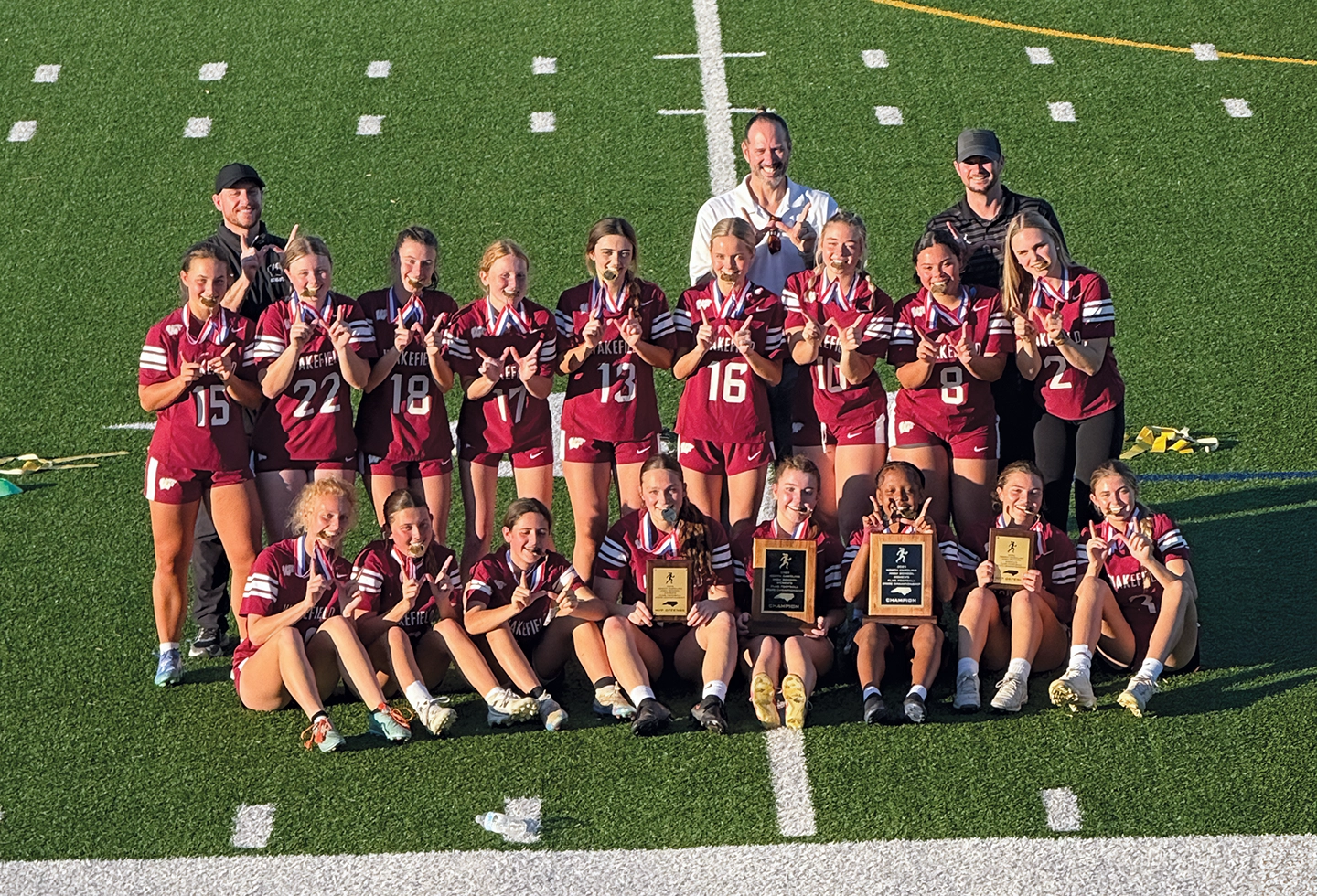
“Through older siblings or watching with their dads, a lot of them have been around the game or thrown the ball around a little bit,” says Wakefield High School coach Kyle Bayer. “A lot of them have been waiting for an opportunity. The hunger and the drive was there, so that was a part that I didn’t need to coach.”
The game differs from tackle football in key ways. Teams play 7-on-7 without contact blocking, and there is no kicking game. Instead, the offense can earn a 1-point conversion from the 3-yard line or a 2-point conversion from the 10-yard line following touchdowns. Flag football is not a contact sport, but the action is fast and competitive.
“(The referees) let the girls play a little bit,” says Apex High School coach Grayson Finchem. “We have screen blocking and different adaptations to make it less of a contact sport, but there’s still contact that takes place. The football is a little bit smaller. We’re not hitting, we’re not in pads, but they’re capable of playing.”
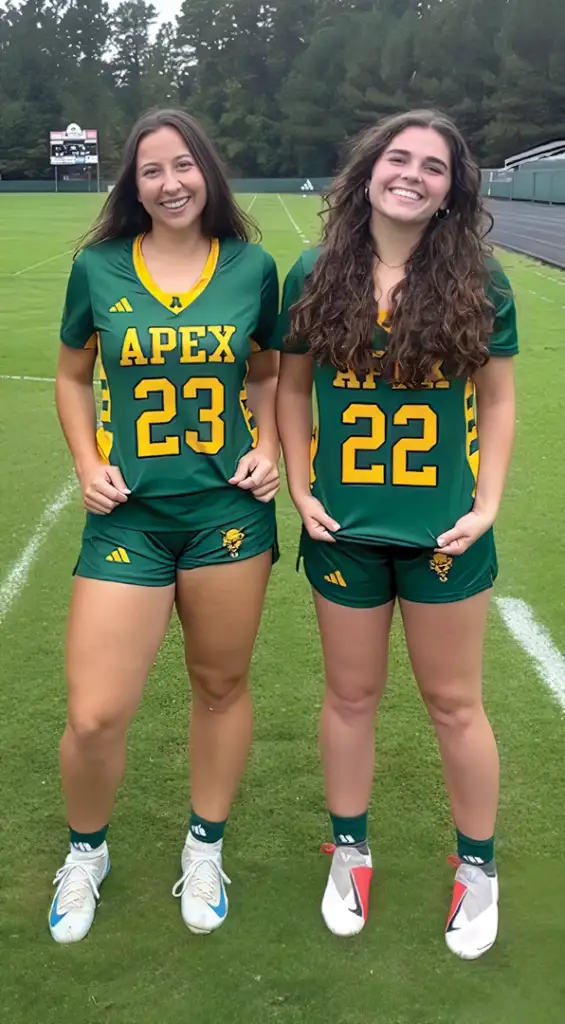
As a little girl, Sarah Fagerstrom loved throwing the football around with her father, brother, and twin sister. But without a way to join a team, she played soccer and ran track. Then came her senior year at Apex, where she took a chance on flag football. As a wide receiver, she caught 22 passes for 275 yards and five touchdowns.
“Oh my goodness, it was like a dream come true,” Fagerstrom says. “You’d get the perfect pass over your shoulder, feel the ball in your hands, tuck in your arm, and run the rest of the way. After you get the touchdown, you look back at your teammates and you see how proud and excited they are.”
Fagerstrom is typical of the players drawn to the sport, bringing skills honed in another discipline. Coaches recruit from a pool of talent that spans the athletic spectrum.
“We’ve had a lot of soccer players, softball players, basketball players,” Bayer says. “We’re able to pick up on what they do well and find positions and roles that match their skill set—and then teach them the game along the way. From a skill standpoint, they are exceptional. We have a girl who can throw a perfect spiral and hit a receiver in stride. We have others who can make a one-handed catch. The talent is there for sure.”
High school flag football participation in the United States reached 102,000 this year, seven times as many who played just four years ago, according to The National Federation of State High School Associations.
“A lot of them, they just want to try something new,” Finchem says. “There’s no background or parameters you need, and it’s a low barrier to entry. They’re learning it at such a rapid pace because it’s not like they’ve had years of playing it. It’s new and shiny, so it’s fun.”
A Girl and Her Football Dream
Coco Lavielle got the bug in middle school. Soccer was her sport, but what she really enjoyed was tossing the ball with the boys on the flag football team. “We would go to the field after school and throw for hours and hours,” she says.
But when she reached Apex High School, she wanted something more from the game.
“I was a competitive dancer at the time, but I wanted something with a ball. I had played soccer all my life,” she says. “As a freshman, I walked up to the athletic director and said, ‘hey, how about we start a flag football team?’”
With help from her mother, Lavielle contacted the Carolina Panthers, who had previously sponsored flag football in Mecklenburg County. Lavielle’s pitch secured $50,000 in grant money for the Wake County Public School System. The donation funded uniforms and equipment to start a pilot program for 20 high school teams across the county.
When the season kicked off with a weekend tournament in January 2024, Lavielle didn’t know what to expect.
“My greatest fear was that the girls wouldn’t want to try out because it’s a new sport,” she says. “That jamboree when everyone tried on the jersey for the first game, there was so much joy and fruitful energy. I would absolutely say there was talent. I was genuinely surprised.”
Lavielle graduated in the spring, but her flag football career is continuing at Meredith College, a Division III program. Her Apex teammate, Sarah Fagerstrom, is playing at Barton College. The Division II school is a member of Conference Carolinas, the first NCAA Division I or II conference to sponsor women’s flag football. The sport was added to the NCAA Emerging Sports for Women program earlier this year for all three divisions, putting flag football on a path to achieve NCAA championship status in the next few years.
“The availability of flag football was monumental to my college commitment at Meredith,” says Lavielle, who will play quarterback and major in business administration. “But I’m also planning for my future, and Meredith has such amazing programs for what I want to do.”
And the football? It’s nothing she can’t handle.
“It’s not scary now because I have great coaches here, and I’ve had great coaches (in high school),” she says. “I’m more prepared because I’ve had the experience and preparation.”
Playing at the college level will extend careers, but the introduction of flag football in high school might change the path of some young students. That’s why the NCHSAA embraced the game.
“Any time there is an opportunity at the next level, we are interested in providing the avenue for those who have the skills to play at that level,” says Que Tucker, commissioner of the NCHSAA. “But we are keenly aware that not all of our young people are going to play at that next level. They play simply for the fun of it or to make friends. It satisfies that general desire for a student to be a part of a team, so we’re excited about that.”
— Kurt Dusterberg