Skip to content Skip to sidebar Skip to footer

From the Garage to the Stage: Shame Gang’s Rise in Raleigh’s Hip-Hop Scene

BY KYLE MARIE McMAHON | PHOTOS BY JESSICA BRATTON 

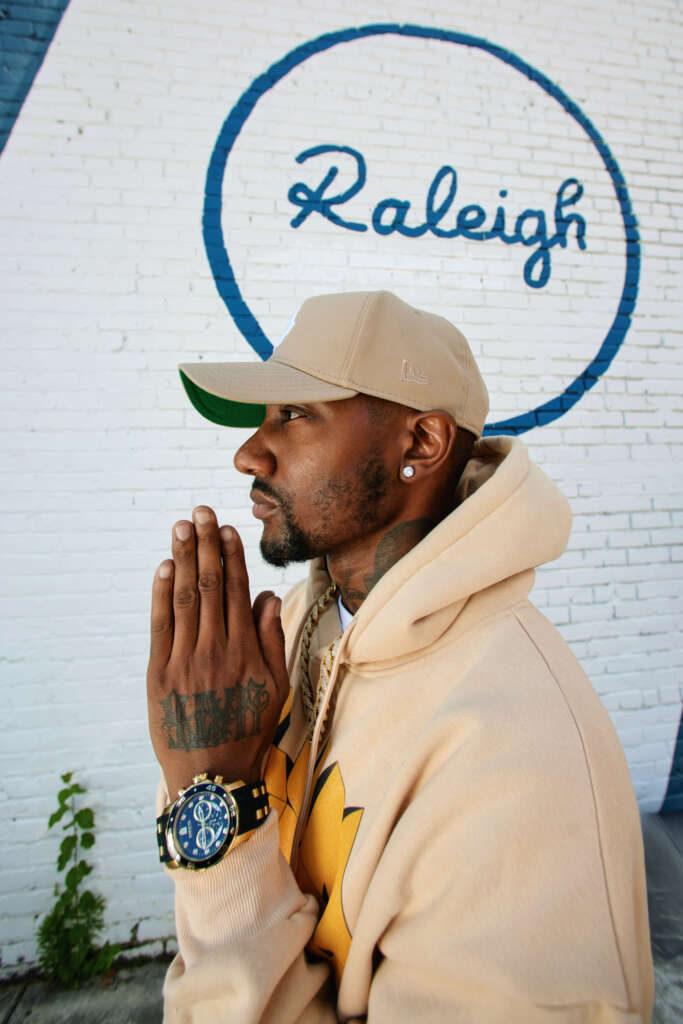
For Darren Clark, the journey to becoming one of Raleigh’s most respected hip-hop artists wasn’t a straight line. It was a path forged through personal tragedy, relentless hard work, and the constant balancing act of two distinct lives: one under the hood of a car and the other in the glow of a studio microphone. A transplant from the D.C. area, Clark (professionally known as Shame Gang) arrived in North Carolina feeling like an outsider but has since become a staple of its vibrant, ever-evolving music scene—a scene he lovingly describes as a “jambalaya pot.” 

Through his deeply personal and versatile music, Shame Gang has not only embraced the Triangle as his second home but has been wholeheartedly embraced by it. His story is one of resilience, artistic integrity, and an unwavering drive to connect with listeners on a human level, proving that in the modern music industry, authenticity is the ultimate currency.

Finding a Home in the Triangle 

When Shame Gang first moved to North Carolina, the path to acceptance felt steep. “I always tried to fit in with everyone else,” he admits. “And then, it got to a point where I was, like, why am I trying to fit in? I’m gonna be myself, and if people rock with it, they just rock with it.” 

That decision to be unapologetically himself paid off. While he initially felt the pressure of being a transplant from Maryland, that outsider perspective fueled a formidable work ethic. He built his name not just through his music, but by actively contributing to the local scene, putting on his own shows and creating platforms for other artists. Over time, Raleigh transformed from a new city into a home base. “Slowly, but surely, it became like, yo, this is my home,” he says. 

His commitment to the community runs deep, extending beyond the stage. In the past, he partnered with the Boys and Girls Club and the Salvation Army in Durham for clothing drives and created opportunities for aspiring young artists. He invited kids from the Boys and Girls Club who were interested in music to his shows, giving them a chance to meet performers and learn how to build a proper set. This spirit of giving

back was the driving force behind his “Shame Sundays” event series. “I just felt like I wanted to give back to the community,” he states, emphasizing that he didn’t want to take money from the people he was trying to help. 

He sees the North Carolina hip-hop landscape as a unique melting pot, distinct from his D.C. roots. “I don’t think North Carolina has a sound,” he explains. “I think it’s just a jambalaya pot of a lot of different artists that come from everywhere … Everybody’s just trying to create their own lane.” It’s in this eclectic environment that Shame Gang has thrived, becoming a key ingredient in the local flavor. Now, he faces the unique challenge of bridging the gap between his two homes, reintroducing himself to the DMV scene not as a visitor, but as the established artist he has become in North Carolina.
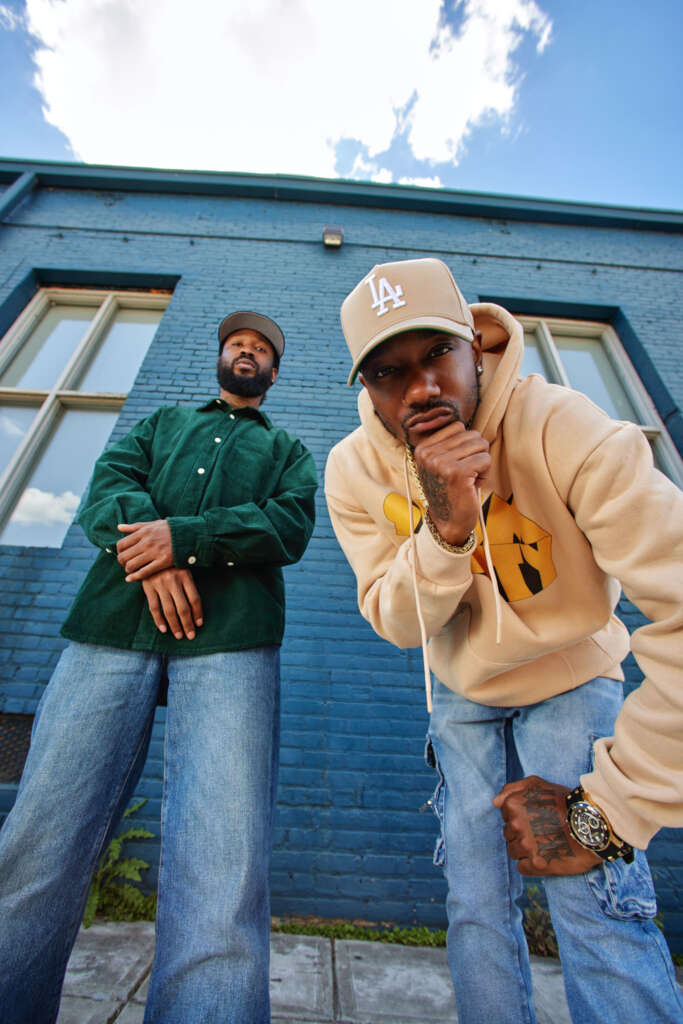
Shame Gang with Charlotte-based rapper Lute.

The Versatile Storyteller 

At the core of Shame Gang’s music is a deep-seated love for the storytelling roots of hip-hop. Citing a Mount Rushmore of influences that includes OutKast, Tupac, J. Cole, and Kendrick Lamar, he aims to make music that resonates on a deeper level than a fleeting viral moment. His lyrical style leans heavily on soul and substance, his music deeply personal and unflinchingly real. 

“What gets me is when people come up to me and say, ‘Hey man, I listened to this song on your first album, and I still listen to it to this day… This song really put me back in the place of thinking of my mom or my dad,'” he shares. “Stuff like that gets me. To me, that’s more powerful than going viral. Just to know that I could potentially make a song that could help someone get through their day.” 

This desire to connect drives his versatility. While his peers sometimes advised him to stick to one style, Shame Gang has always prided himself on his ability to navigate different sonic landscapes. “I can give you a song like the mic drop one I did [with Block Work.tv], you know, the hip-hop, traditional way. I can give you a song that you can play in the clubs, too. I can give you a song that might be a little bit R&B-ish as well,” he says. “I look at the artists that I came up under … Tupac could give you a song like ‘Dear Mama,’ but then make ‘I Get Around’ or ‘Temptations.’ That’s the type of hip-hop I came up on, where it don’t have to be always serious all the time.”
From Tragedy to Triumph 

Shame Gang’s artistic journey is inextricably linked to his older brother, the late rapper Manifest, who was his biggest inspiration. “My brother was the whole reason why I got into rap,” he says. When his brother was killed five years ago, the loss was devastating

and nearly ended his career. 

“I wanted to quit rap,” he confesses. He took six months off from writing, and when he returned, his confidence was shattered. The turning point came during the creation of his 2021 album, No Safe Haven. He had to channel his grief into his art to move forward. The song “Still Here,” dedicated to his brother, was born from a grueling, five-hour studio session. “I cried for the first two,” he recalls. “Every time I look at the behind-the-scenes video … it just reminds me of how I felt that whole year. That was my most meaningful album because I had to push so hard.” 

That album, forged in pain, became his defining moment. It was where he shed the need to impress his peers and found his own, authentic sound. “When I got to No Safe Haven, I was like, I want to have fun. I’m healing. So I was like, I gotta get these songs off and express how I feel,” he explains. “When I got to Better Late Than Never, it was like, now I’m really gonna have fun. I’m comfortable with myself. I know how I want to sound.” 

That comfort is also rooted in his life outside of music as a car mechanic. His 2023 album, Better Late Than Never, chronicles the real-life struggle of juggling his day job with his rap career—showing up to work late after driving back from a show in Atlanta, exhausted but determined. This dual identity keeps him grounded and provides the raw, relatable material that defines his music. 

A Listener’s Guide to Shame Gang 

For those new to his music, Shame Gang offers a curated playlist to showcase his versatility. 

  • For a trap vibe: “Million and One” (Better Late Than Never). This track captures his hunger and urgency, perfect for a high-energy mood. 
  • For introspection and bar-heavy lyricism: “Hyperventilate” (Better Late Than Never). A collaboration with Skyzoo, the song is a two-part journey. The first half is pure lyrical skill, while the second half is a relatable anthem about finding a way out of tough situations. 
  • For when you just want to talk your talk: “No Limit” (No Safe Haven). A track full of confidence and swagger. 
  • For a nostalgic, ’90s R&B feel: “Forbidden Fruit.” One of his latest singles, which he describes as having a smooth, nostalgic vibe. 
  • For a heartfelt connection: “Okay” (Genesis 98′). Perhaps one of his most meaningful tracks, written for a close friend who was battling cancer. He recalls how his visits would make her forget her pain, and the song captures that

profound power of human connection. “A lot of songs that people came to me and was like, ‘Yo, this song made me think of my mom.’ It’s a heart-warmer.”

The Road Ahead 

Shame Gang’s relentless drive continues. He’s preparing to release a new five-track EP, Oil Stains and 808s, on August 17th, his first project under a new deal with Steve Lobel’s Lobel Music Group. An EP release show is set for the night before at Kings in Raleigh. 

Beyond that, the future is brimming with possibilities. There’s talk of joining fellow North Carolina artist and collaborator Lute on tour next year. He’s also planning a sequel to his last album, tentatively titled Never Late is Better, which will explore his new life as a business owner balancing his art. He plans to open his auto shop, Shame Gang Automotive, to the public next year, a move that will bring his two worlds even closer together. 

And in the long term, he hopes to pay forward the mentorship he received by launching a label in his brother’s name, Manifest Destiny Records. “I always told myself if I do ever get behind the scenes, I really want to help artists,” he says. “I’d rather just mentor people and see if I can make it easier for them, because I know the journey is hard.” 

From a transplant finding his footing to a pillar of the local scene, Shame Gang has built more than a career in North Carolina—he’s built a legacy on his own terms. And as he continues to tell his story, both in the studio and in the garage, it’s clear his journey is far from over.

© 2008-2025 Midtown magazine, LLC. All rights reserved. Copyright applies to all pages on this website. | Privacy Policy

BY KYLE MARIE McMAHON | PHOTOS BY JESSICA BRATTON 

For Darren Clark, the journey to becoming one of Raleigh’s most respected hip-hop artists wasn’t a straight line. It was a path forged through personal tragedy, relentless hard work, and the constant balancing act of two distinct lives: one under the hood of a car and the other in the glow of a studio microphone. A transplant from the D.C. area, Clark (professionally known as Shame Gang) arrived in North Carolina feeling like an outsider but has since become a staple of its vibrant, ever-evolving music scene—a scene he lovingly describes as a “jambalaya pot.” 

Through his deeply personal and versatile music, Shame Gang has not only embraced the Triangle as his second home but has been wholeheartedly embraced by it. His story is one of resilience, artistic integrity, and an unwavering drive to connect with listeners on a human level, proving that in the modern music industry, authenticity is the ultimate currency.

Finding a Home in the Triangle 

When Shame Gang first moved to North Carolina, the path to acceptance felt steep. “I always tried to fit in with everyone else,” he admits. “And then, it got to a point where I was, like, why am I trying to fit in? I’m gonna be myself, and if people rock with it, they just rock with it.” 

That decision to be unapologetically himself paid off. While he initially felt the pressure of being a transplant from Maryland, that outsider perspective fueled a formidable work ethic. He built his name not just through his music, but by actively contributing to the local scene, putting on his own shows and creating platforms for other artists. Over time, Raleigh transformed from a new city into a home base. “Slowly, but surely, it became like, yo, this is my home,” he says. 

His commitment to the community runs deep, extending beyond the stage. In the past, he partnered with the Boys and Girls Club and the Salvation Army in Durham for clothing drives and created opportunities for aspiring young artists. He invited kids from the Boys and Girls Club who were interested in music to his shows, giving them a chance to meet performers and learn how to build a proper set. This spirit of giving

back was the driving force behind his “Shame Sundays” event series. “I just felt like I wanted to give back to the community,” he states, emphasizing that he didn’t want to take money from the people he was trying to help. 

He sees the North Carolina hip-hop landscape as a unique melting pot, distinct from his D.C. roots. “I don’t think North Carolina has a sound,” he explains. “I think it’s just a jambalaya pot of a lot of different artists that come from everywhere … Everybody’s just trying to create their own lane.” It’s in this eclectic environment that Shame Gang has thrived, becoming a key ingredient in the local flavor. Now, he faces the unique challenge of bridging the gap between his two homes, reintroducing himself to the DMV scene not as a visitor, but as the established artist he has become in North Carolina.

Shame Gang with Charlotte-based rapper Lute.

The Versatile Storyteller 

At the core of Shame Gang’s music is a deep-seated love for the storytelling roots of hip-hop. Citing a Mount Rushmore of influences that includes OutKast, Tupac, J. Cole, and Kendrick Lamar, he aims to make music that resonates on a deeper level than a fleeting viral moment. His lyrical style leans heavily on soul and substance, his music deeply personal and unflinchingly real. 

“What gets me is when people come up to me and say, ‘Hey man, I listened to this song on your first album, and I still listen to it to this day… This song really put me back in the place of thinking of my mom or my dad,'” he shares. “Stuff like that gets me. To me, that’s more powerful than going viral. Just to know that I could potentially make a song that could help someone get through their day.” 

This desire to connect drives his versatility. While his peers sometimes advised him to stick to one style, Shame Gang has always prided himself on his ability to navigate different sonic landscapes. “I can give you a song like the mic drop one I did [with Block Work.tv], you know, the hip-hop, traditional way. I can give you a song that you can play in the clubs, too. I can give you a song that might be a little bit R&B-ish as well,” he says. “I look at the artists that I came up under … Tupac could give you a song like ‘Dear Mama,’ but then make ‘I Get Around’ or ‘Temptations.’ That’s the type of hip-hop I came up on, where it don’t have to be always serious all the time.”

From Tragedy to Triumph 

Shame Gang’s artistic journey is inextricably linked to his older brother, the late rapper Manifest, who was his biggest inspiration. “My brother was the whole reason why I got into rap,” he says. When his brother was killed five years ago, the loss was devastating

and nearly ended his career. 

“I wanted to quit rap,” he confesses. He took six months off from writing, and when he returned, his confidence was shattered. The turning point came during the creation of his 2021 album, No Safe Haven. He had to channel his grief into his art to move forward. The song “Still Here,” dedicated to his brother, was born from a grueling, five-hour studio session. “I cried for the first two,” he recalls. “Every time I look at the behind-the-scenes video … it just reminds me of how I felt that whole year. That was my most meaningful album because I had to push so hard.” 

That album, forged in pain, became his defining moment. It was where he shed the need to impress his peers and found his own, authentic sound. “When I got to No Safe Haven, I was like, I want to have fun. I’m healing. So I was like, I gotta get these songs off and express how I feel,” he explains. “When I got to Better Late Than Never, it was like, now I’m really gonna have fun. I’m comfortable with myself. I know how I want to sound.” 

That comfort is also rooted in his life outside of music as a car mechanic. His 2023 album, Better Late Than Never, chronicles the real-life struggle of juggling his day job with his rap career—showing up to work late after driving back from a show in Atlanta, exhausted but determined. This dual identity keeps him grounded and provides the raw, relatable material that defines his music. 

A Listener’s Guide to Shame Gang 

For those new to his music, Shame Gang offers a curated playlist to showcase his versatility. 

  • For a trap vibe: “Million and One” (Better Late Than Never). This track captures his hunger and urgency, perfect for a high-energy mood. 
  • For introspection and bar-heavy lyricism: “Hyperventilate” (Better Late Than Never). A collaboration with Skyzoo, the song is a two-part journey. The first half is pure lyrical skill, while the second half is a relatable anthem about finding a way out of tough situations. 
  • For when you just want to talk your talk: “No Limit” (No Safe Haven). A track full of confidence and swagger. 
  • For a nostalgic, ’90s R&B feel: “Forbidden Fruit.” One of his latest singles, which he describes as having a smooth, nostalgic vibe. 
  • For a heartfelt connection: “Okay” (Genesis 98′). Perhaps one of his most meaningful tracks, written for a close friend who was battling cancer. He recalls how his visits would make her forget her pain, and the song captures that

profound power of human connection. “A lot of songs that people came to me and was like, ‘Yo, this song made me think of my mom.’ It’s a heart-warmer.”

The Road Ahead 

Shame Gang’s relentless drive continues. He’s preparing to release a new five-track EP, Oil Stains and 808s, on August 17th, his first project under a new deal with Steve Lobel’s Lobel Music Group. An EP release show is set for the night before at Kings in Raleigh. 

Beyond that, the future is brimming with possibilities. There’s talk of joining fellow North Carolina artist and collaborator Lute on tour next year. He’s also planning a sequel to his last album, tentatively titled Never Late is Better, which will explore his new life as a business owner balancing his art. He plans to open his auto shop, Shame Gang Automotive, to the public next year, a move that will bring his two worlds even closer together. 

And in the long term, he hopes to pay forward the mentorship he received by launching a label in his brother’s name, Manifest Destiny Records. “I always told myself if I do ever get behind the scenes, I really want to help artists,” he says. “I’d rather just mentor people and see if I can make it easier for them, because I know the journey is hard.” 

From a transplant finding his footing to a pillar of the local scene, Shame Gang has built more than a career in North Carolina—he’s built a legacy on his own terms. And as he continues to tell his story, both in the studio and in the garage, it’s clear his journey is far from over.
This Pop-up Is Included in the Theme
Best Choice for Creatives
Purchase Now