
Skip to content Skip to sidebar Skip to footer

Goats on the Go Helps Carolina Tiger Rescue Clear the Way

Goats on the Go Raleigh Durham

By Dathan Kazsuk

There are a few things you expect to see during an afternoon visit to Carolina Tiger Rescue in Pittsboro.

Tigers, of course. Maybe a lion. A few rescued wild cats pacing, lounging, or reminding you, rather quickly, that your house cat is basically a tiny freeloader with better PR.

What you might not expect to see is a crew of goats on the job.

That is where Stephen Paul comes in.

Paul operates Goats On The Go Raleigh-Durham, the local affiliate of a national network that uses goats for targeted grazing, brush control, and invasive plant management. Instead of bringing in noisy equipment or spraying herbicides across overgrown areas, the goats do what goats do best: eat. Kudzu, privet, English ivy, poison ivy, and other stubborn plants that can take over North Carolina landscapes are all part of the menu.

At Carolina Tiger Rescue, the goats are serving a dual purpose. They are helping clear invasive vegetation in areas around the sanctuary, and they are doing it in a way that is far less disruptive to the rescued animals that live there. For a place where many animals come from stressful or improper captive situations, quiet matters. A herd of goats moving through brush makes a very different kind of sound than chainsaws, mowers, or heavy machinery.

It also makes for one of the more unexpected scenes you’ll find in the Triangle: rescued big cats watching a herd of goats clock in for the day.

I met Paul during a private tour of Carolina Tiger Rescue, where we talked in between stops to see the sanctuary’s animals before making our way down to the goats. During the tour, I had time to ask him a few questions about how he went from corporate IT to goatscaping, why goats are so effective, and what it is like to manage a four-legged landscaping crew.
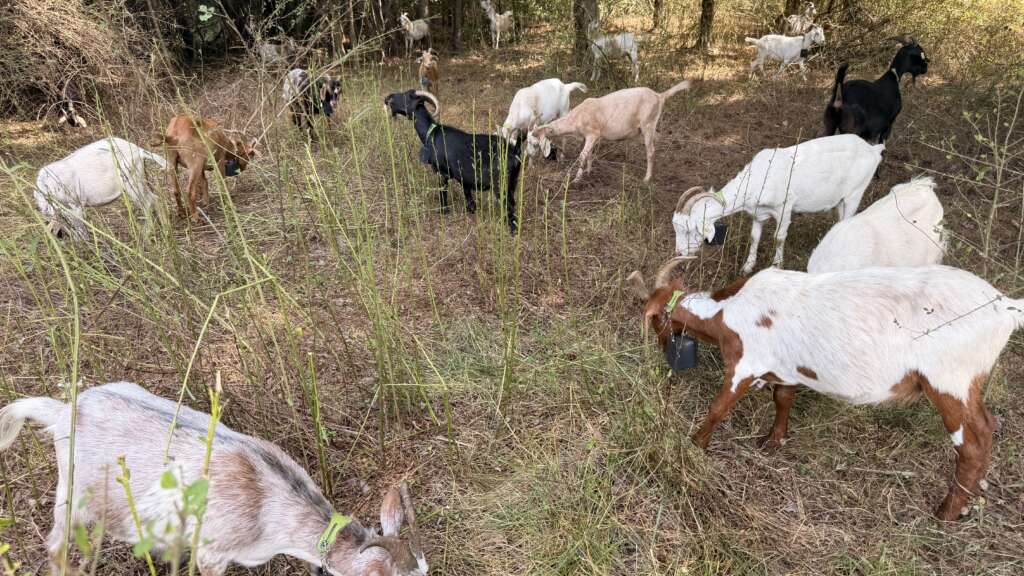
Goats on the Go Raleigh-Durham
Photo by Dathan Kazsuk.

How did you get into goatscaping?

I’m originally from England, and in my late 20s, I moved to Australia. I was working in corporate IT, but during my time there, I really started falling in love with nature. I got inspired to transition from working behind a desk to actually working outside in nature.

I became interested in livestock, land regeneration, and producing healthy animal products. I eventually came to the United States, but I quickly realized it’s very challenging to make a living with a small livestock holding.

Because of my technology background, I was also really interested in virtual fence technology, which is very new for livestock. I got connected with a Norwegian company called Nofence, and they put me in touch with people in America who were using this new technology for goatscaping. That inspired me to start a goatscaping business.

I traveled around the United States for about a year and a half, visited around 20 states, and eventually chose this part of North Carolina to start the business about three years ago. I then chose to affiliate with Goats On The Go, which is a national network across the country.

How many goats do you own?

I have roughly 140 goats.
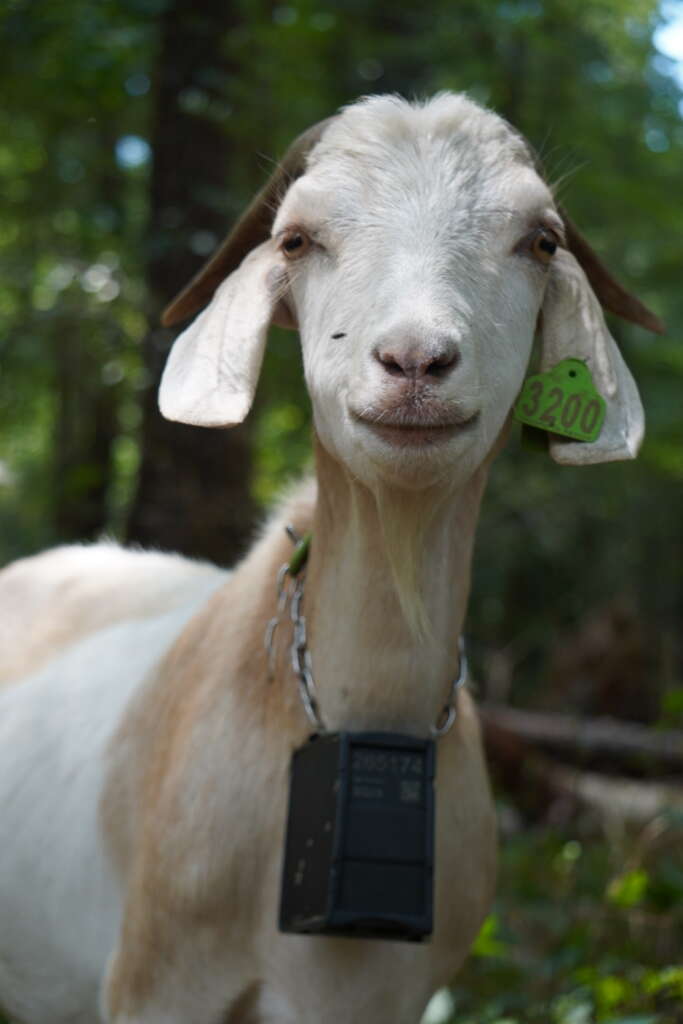
Goats on the Go Raleigh-Durham
One of Paul's many goats. Photo courtesy Bob Karp/Walter Magazine.

Do you have a farm where you keep them all?

Actually, I personally don’t own any land. One of the great things about starting a goat business is that landowners are often very happy to have goats on their land because they do such a good job clearing and maintaining it.

I’ve made barter relationships with different landowners. When the goats aren’t working, especially in the wintertime, the landowners benefit from the goats clearing weedy areas and depositing natural fertilizer. In exchange, the goats get a home base.

How did you get connected with Carolina Tiger Rescue?

During the winter, we had a pretty harsh season and lost a few animals. I had heard that Carolina Tiger Rescue accepted deceased animals to help with the nutrition of the tigers, so I brought some here.

In the process of getting to know the people here, they saw my truck and realized what I do. Eventually, the conversation became, “We should actually get your goats out here,” not to feed the tigers, but to help clean up the property.

We stayed in touch, developed a relationship, toured the complex, and decided what areas would be the best place to start applying goats.

How quickly can goats clear an area?

The rough rule of thumb is that about 30 goats can eat through an acre of land in five to seven days.

Of course, that depends on the density of the brush, the type of vegetation and the weather. Extreme heat and rain can slow goats down because they don’t like to work as much in those conditions.
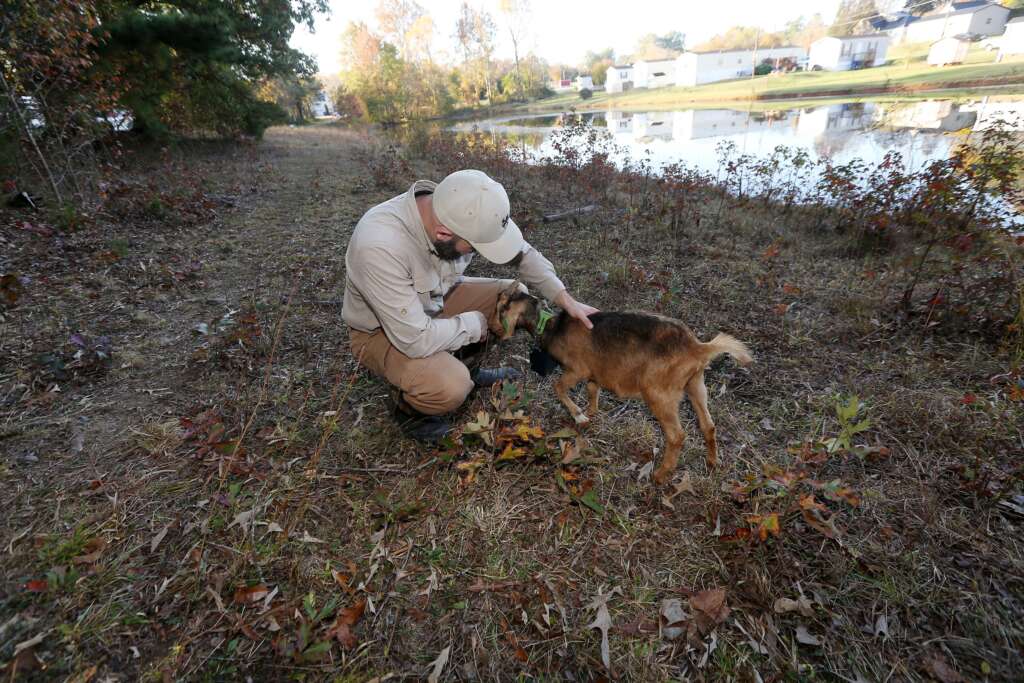
Goats on the Go Raleigh-Durham
Stephen Paul with one of his goats. Photo courtesy of Bob Karp/Walter Magazine.

Do goats spread the seeds from the plants they eat?

What’s really interesting is that goats destroy the majority of the seeds they eat in their rumen. So when the seeds pass through them, most are no longer viable.

That’s one reason goats can be so effective over a period of a few years. They’re not just eating the plants. They’re also helping reduce the spread of the problem.

What kinds of plants do goats like most?

Kudzu is basically a match made in heaven for goats. It’s incredibly high in protein, and the goats gorge on it. I would say that’s the ideal forage for them.

They’ll also eat a lot of English ivy, which is a common problem in this area. We get a lot of calls for English ivy because it takes over backyards and wooded areas. The goats will eat the majority of the leaves and really help customers get on top of that problem.

They also love poison ivy.

Wait, goats love poison ivy?

They adore poison ivy.

That’s good to know, because I seem to get it every year.

It’s important to understand that when goats enter an area, they won’t kill most vegetation immediately. They’ll eat it down, but a lot of it will grow back.

The principle of goatscaping is to bring them back on a careful schedule to repeatedly graze the vegetation and exhaust it over time. It’s not usually a one-and-done approach.

The exception can be saplings or smooth-barked trees. Goats can strip the bark off certain trees, and that can kill them. Some customers actually like that side benefit when they are trying to clear unwanted growth.
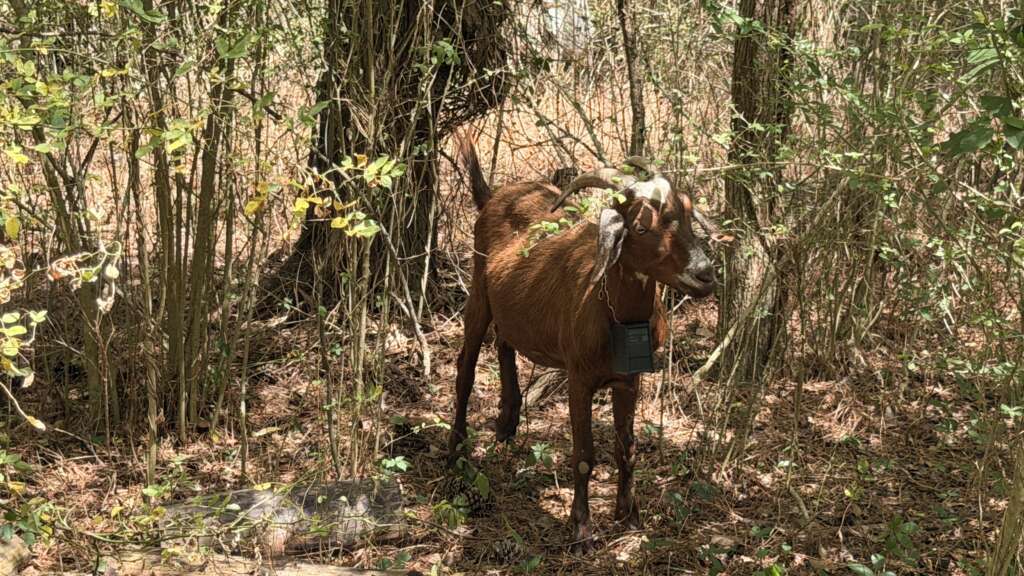
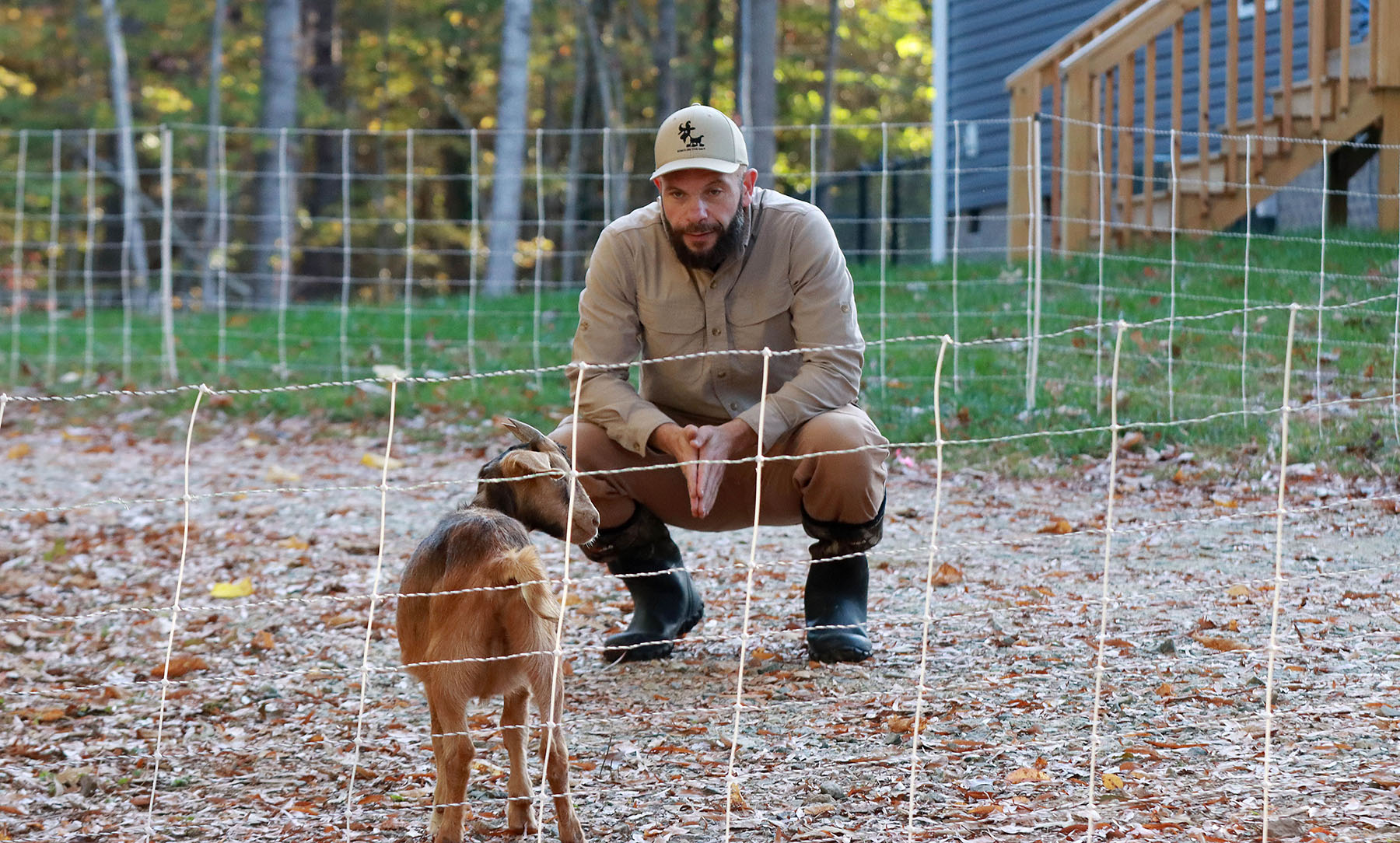
Goats on the Go Raleigh Durham Carolina Tiger Resuce
Photo by Dathan Kazsuk.

Why are goats a good option for people who don’t want to use chemicals?

The majority of our customers are sensitive to that. Many people have dogs and don’t want them in areas where herbicides have been sprayed. The City of Raleigh also has many wet areas where they don’t want to broadcast herbicide.

Goats are a really eco-friendly way of managing vegetation. They can go places machinery can’t, and they don’t come with the same noise, fuel, or chemical concerns.

We actually had a customer cancel a project because a mosquito-spraying company came out without her knowing and sprayed the vegetation. We couldn’t bring the goats in after that. Typically, we need to wait at least a month.

Do goats have different personalities?

Oh, yes. You’ll see it when you meet them. Some are friendlier, some are more dominant, some are playful, and some are more skittish.

A few of ours were bottle-raised because their mothers rejected them. Those goats tend to be much friendlier with people. They’re food-motivated; they want pets, and a lot of our customers love interacting with those particular goats.

We don’t name all of them because we have about 140, but if they stand out, they get a name.

Do you ever lose any goats?

We have a GPS collar on every single goat that’s old enough to wear one, usually around four to six months old.

The goats here are currently contained with GPS, though we do use electric fencing on certain projects. GPS allows us to fence in areas that are difficult to physically fence.

Sometimes goats do escape. It’s usually when one gets stressed during loading or gets confused in that process. The good thing is that we know where the goat is.

Thankfully, we’ve only had goats at large once or twice in the company’s history, and only once has animal control had to come out.

© 2008-2025 Midtown magazine, LLC. All rights reserved. Copyright applies to all pages on this website. | Privacy Policy

By Dathan Kazsuk

There are a few things you expect to see during an afternoon visit to Carolina Tiger Rescue in Pittsboro.

Tigers, of course. Maybe a lion. A few rescued wild cats pacing, lounging, or reminding you, rather quickly, that your house cat is basically a tiny freeloader with better PR.

What you might not expect to see is a crew of goats on the job.

That is where Stephen Paul comes in.

Paul operates Goats On The Go Raleigh-Durham, the local affiliate of a national network that uses goats for targeted grazing, brush control, and invasive plant management. Instead of bringing in noisy equipment or spraying herbicides across overgrown areas, the goats do what goats do best: eat. Kudzu, privet, English ivy, poison ivy, and other stubborn plants that can take over North Carolina landscapes are all part of the menu.

At Carolina Tiger Rescue, the goats are serving a dual purpose. They are helping clear invasive vegetation in areas around the sanctuary, and they are doing it in a way that is far less disruptive to the rescued animals that live there. For a place where many animals come from stressful or improper captive situations, quiet matters. A herd of goats moving through brush makes a very different kind of sound than chainsaws, mowers, or heavy machinery.

It also makes for one of the more unexpected scenes you’ll find in the Triangle: rescued big cats watching a herd of goats clock in for the day.

I met Paul during a private tour of Carolina Tiger Rescue, where we talked in between stops to see the sanctuary’s animals before making our way down to the goats. During the tour, I had time to ask him a few questions about how he went from corporate IT to goatscaping, why goats are so effective, and what it is like to manage a four-legged landscaping crew.

Goats on the Go Raleigh-Durham
Photo by Dathan Kazsuk.

How did you get into goatscaping?

I’m originally from England, and in my late 20s, I moved to Australia. I was working in corporate IT, but during my time there, I really started falling in love with nature. I got inspired to transition from working behind a desk to actually working outside in nature.

I became interested in livestock, land regeneration, and producing healthy animal products. I eventually came to the United States, but I quickly realized it’s very challenging to make a living with a small livestock holding.

Because of my technology background, I was also really interested in virtual fence technology, which is very new for livestock. I got connected with a Norwegian company called Nofence, and they put me in touch with people in America who were using this new technology for goatscaping. That inspired me to start a goatscaping business.

I traveled around the United States for about a year and a half, visited around 20 states, and eventually chose this part of North Carolina to start the business about three years ago. I then chose to affiliate with Goats On The Go, which is a national network across the country.

How many goats do you own?

I have roughly 140 goats.

Goats on the Go Raleigh-Durham
One of Paul's many goats. Photo courtesy Bob Karp/Walter Magazine.

Do you have a farm where you keep them all?

Actually, I personally don’t own any land. One of the great things about starting a goat business is that landowners are often very happy to have goats on their land because they do such a good job clearing and maintaining it.

I’ve made barter relationships with different landowners. When the goats aren’t working, especially in the wintertime, the landowners benefit from the goats clearing weedy areas and depositing natural fertilizer. In exchange, the goats get a home base.

How did you get connected with Carolina Tiger Rescue?

During the winter, we had a pretty harsh season and lost a few animals. I had heard that Carolina Tiger Rescue accepted deceased animals to help with the nutrition of the tigers, so I brought some here.

In the process of getting to know the people here, they saw my truck and realized what I do. Eventually, the conversation became, “We should actually get your goats out here,” not to feed the tigers, but to help clean up the property.

We stayed in touch, developed a relationship, toured the complex, and decided what areas would be the best place to start applying goats.

How quickly can goats clear an area?

The rough rule of thumb is that about 30 goats can eat through an acre of land in five to seven days.

Of course, that depends on the density of the brush, the type of vegetation and the weather. Extreme heat and rain can slow goats down because they don’t like to work as much in those conditions.

Goats on the Go Raleigh-Durham
Stephen Paul with one of his goats. Photo courtesy of Bob Karp/Walter Magazine.

Do goats spread the seeds from the plants they eat?

What’s really interesting is that goats destroy the majority of the seeds they eat in their rumen. So when the seeds pass through them, most are no longer viable.

That’s one reason goats can be so effective over a period of a few years. They’re not just eating the plants. They’re also helping reduce the spread of the problem.

What kinds of plants do goats like most?

Kudzu is basically a match made in heaven for goats. It’s incredibly high in protein, and the goats gorge on it. I would say that’s the ideal forage for them.

They’ll also eat a lot of English ivy, which is a common problem in this area. We get a lot of calls for English ivy because it takes over backyards and wooded areas. The goats will eat the majority of the leaves and really help customers get on top of that problem.

They also love poison ivy.

Wait, goats love poison ivy?

They adore poison ivy.

That’s good to know, because I seem to get it every year.

It’s important to understand that when goats enter an area, they won’t kill most vegetation immediately. They’ll eat it down, but a lot of it will grow back.

The principle of goatscaping is to bring them back on a careful schedule to repeatedly graze the vegetation and exhaust it over time. It’s not usually a one-and-done approach.

The exception can be saplings or smooth-barked trees. Goats can strip the bark off certain trees, and that can kill them. Some customers actually like that side benefit when they are trying to clear unwanted growth.

Goats on the Go Raleigh Durham Carolina Tiger Resuce
Photo by Dathan Kazsuk.

Why are goats a good option for people who don’t want to use chemicals?

The majority of our customers are sensitive to that. Many people have dogs and don’t want them in areas where herbicides have been sprayed. The City of Raleigh also has many wet areas where they don’t want to broadcast herbicide.

Goats are a really eco-friendly way of managing vegetation. They can go places machinery can’t, and they don’t come with the same noise, fuel, or chemical concerns.

We actually had a customer cancel a project because a mosquito-spraying company came out without her knowing and sprayed the vegetation. We couldn’t bring the goats in after that. Typically, we need to wait at least a month.

Do goats have different personalities?

Oh, yes. You’ll see it when you meet them. Some are friendlier, some are more dominant, some are playful, and some are more skittish.

A few of ours were bottle-raised because their mothers rejected them. Those goats tend to be much friendlier with people. They’re food-motivated; they want pets, and a lot of our customers love interacting with those particular goats.

We don’t name all of them because we have about 140, but if they stand out, they get a name.

Do you ever lose any goats?

We have a GPS collar on every single goat that’s old enough to wear one, usually around four to six months old.

The goats here are currently contained with GPS, though we do use electric fencing on certain projects. GPS allows us to fence in areas that are difficult to physically fence.

Sometimes goats do escape. It’s usually when one gets stressed during loading or gets confused in that process. The good thing is that we know where the goat is.

Thankfully, we’ve only had goats at large once or twice in the company’s history, and only once has animal control had to come out.

This Pop-up Is Included in the Theme
Best Choice for Creatives
Purchase Now